

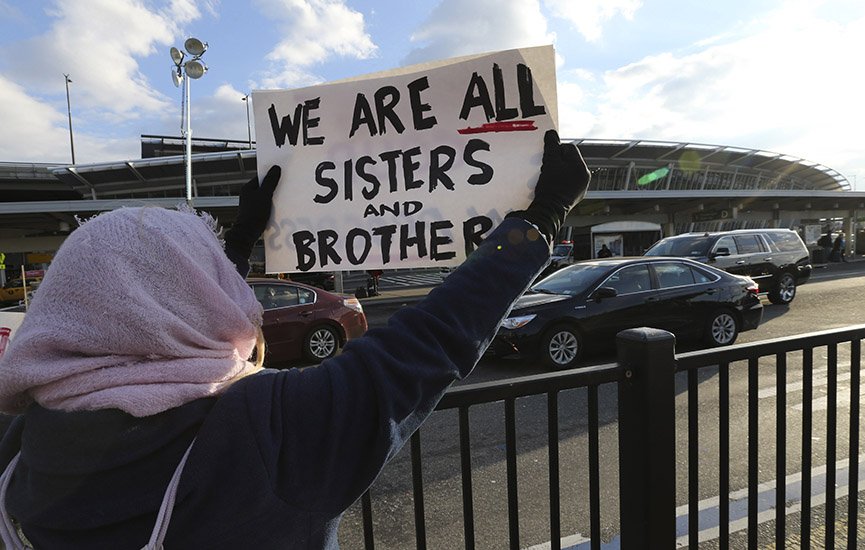
The mood among American business leaders regarding the Trump presidency seems to have shifted since Inauguration Day from cautious optimism to general wariness, and that shift may have unexpected consequences: a lobbying boom in Washington and decreased hiring by American companies.
According to new research from the University of Chicago Booth School of Business, when executives of public companies see heightened levels of what’s called “idiosyncratic political risk”—political threats targeted at their industries or bottom lines—they both ramp up spending on lobbying activities and deemphasize hiring, job creation and R&D activities.

Idiosyncratic political risk could be “that you make an insulin pump and the FDA comes and has higher standards for that all of a sudden,” says Tarek Hassan, the lead author of the paper and an associate professor of finance and economics at the University of Chicago Booth School of Business. “Another example is that you’re really not doing anything wrong, but Trump decided that today he’s going to bully you to stop outsourcing to Mexico. We find that the more of this idiosyncratic political risk you have, the less you hire and the less you invest, and instead you invest more in donating to politicians and lobbying Congress.”
The researchers analyzed eight years’ worth of earnings calls—89,897 calls in all—using a computer algorithm that picked up politically significant phrases—such as “FAA” or “H1-B” or “NAFTA.” The researchers posited that an increase in the frequency of these phrases indicated heightened political tension around the topic. They then compared this data to the rate of corporate spending on lobbying activity. The finding was significant: An increase of one standard deviation in perceived political risk, as indicated by an increase in attention to a topic in analyst calls, translated to a 4 percent increase in lobbying activity around that issue.
The finding quantifies what most people would assume—that when a business topic is on the government’s radar, you can expect more lobbying around it. And indeed, just this week several top executives at major corporations indicated that they would be boosting their lobbying efforts in response to Trump’s immigration ban, which blocked legal immigrants and green card holders from seven predominantly Muslim nations from entering the U.S. (After nationwide protests, the White House amended the ban to exclude green card holders.)
“We have many employees from the named countries, and we do business all over the region,” GE CEO Jeffrey Immelt wrote in an email to the company. He added that those employees were “critical” to the success of the company, and that he would “continue to make our voice heard with the new administration and Congress and reiterate the importance of this issue.”
Tech and engineering centric companies are especially affected by the ban as they often rely on industry experts from around the world. Tesla CEO Elon Musk tweeted that he would petition Trump to amend the executive order:
Please read immigration order. Lmk specific amendments. Will seek advisory council consensus & present to President. https://t.co/qLpbsP4lEk
— Elon Musk (@elonmusk) January 29, 2017
Political risk does not only drain companies’ financial resources as they shift dollars to lobbying and slow hiring and research, but also their “administrative capacity,” says Hassan. Therefore, if company productivity is finite, the more energy a company and its executives have to spend dealing with turbulence out of Washington, the less it has to invest in developing and improving products and marketing to consumers.
Heightened risk is not just an issue for individual companies, Hassan says—it may have long-term detrimental effects on GDP. “A major determinant for economic development in any country is the shocks that come from the political system,” he says. “Argentina used to be super rich, and then they started having this succession of political crises and started sliding down the income distribution in the world. Think of Russia and Venezuela. There’s lots of historical examples of shocks from the political system that diminish the country’s capacity to grow economically.”

The difference, of course, is that those countries are still emerging or Third World economies. Now, scholars must consider the possibility that “these issues also are at play in developed countries” like the U.S., says Hassan. Historically, the only thing that has protected the U.S. from serious political shocks has been the strength of Constitutional checks and balances. If those weaken, the only winners may be the lobbyists.
Source: “Aggregate and Idiosyncratic Political Risk: Measurement and Effects” by Tarek Hassan, Stephan Hollander, Laurence van Lent and Ahmed Tahoun