

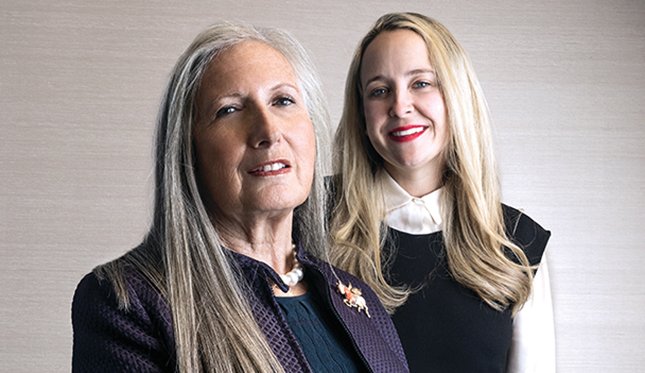
Alexa von Tobel was a Harvard grad with a stint at Morgan Stanley when she came up with the idea for LearnVest.com, a personal finance website. “I had gotten into Harvard Business School, but I literally knew nothing about my wallet,” she remembers. “How many credit cards should I have? Should I opt into the dental insurance plan? How much should I be saving?” She wrote a business plan for the site, went to HBS—and then took a leave of absence to start the company in 2009. LearnVest grew into a sophisticated fintech firm with 1.5 million users and $75 million in venture financing. In 2015, Northwestern Mutual acquired LearnVest for a reported $250 million and named von Tobel Northwestern’s chief digital officer.
It’s the kind of success story that was hard to imagine in 1977, when Josephine Linden came to the U.S. from her native Australia. Relatively few women are in finance today; 40 years ago the numbers were infinitesimal. But after earning an MBA from the University of Chicago in 1983, Linden gained an entry position at Goldman Sachs, where she spent 26 years, becoming a managing director and partner. “It’s an incredible organization,” she says. “It does a really good job of hiring the very best people, and then it does an equally good job of making sure that those people are trained, motivated, challenged and intellectually stimulated.” In 2011, Linden started her own wealth management firm, Linden Global Strategies, which manages more than $5 billion for clients including Australian prime minister Malcolm Turnbull and the Prince of Wales Foundation.


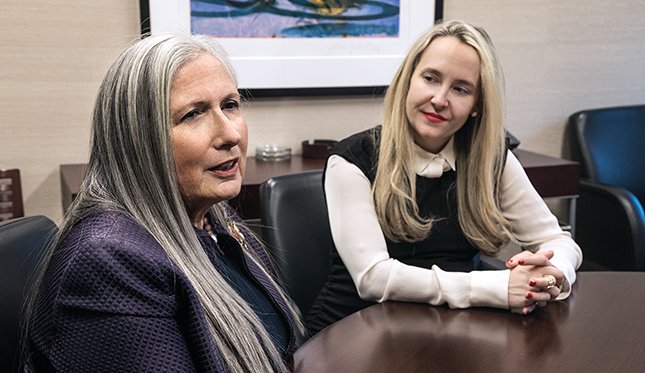
Linden and von Tobel met for the first time at Linden Global’s headquarters near Manhattan’s Rockefeller Center on a chilly December afternoon. “Aren’t you lovely,” von Tobel said to Linden as she walked in the door. Midway through the talk, Linden declared herself “a fan” of von Tobel’s. The mutual admiration was born out of shared thinking. Following are highlights from their conversation.
WORTH: How difficult is it to be a woman in finance today?
Alexa von Tobel: I actually don’t feel like my gender had a huge role in my job, and I think that’s probably because of great people like Josephine before me who worked really hard to make the environment more neutral.
Do you think that’s true for women generally?
AVT: We clearly have tons of things that we need to work through in the workplace of all shapes and sizes, and gender is one of them.
Josephine Linden: If you talk about the number of women in finance, whether you’re looking at private equity or hedge funds or advisors—no matter which way you color it, there are far fewer women in that role.
Why is that?
JL: There are two sides of getting people into an industry. One is the people who are hiring, and the second is the people who are being hired. Now, as opposed to when I first got into the business, there are far more people who are actually looking to hire people of diversity—whether it be a gender issue or race. People are looking for diversity because that’s what the client base is, diverse.
On the other hand, there are fewer women who look for a career in finance. If you go to the business schools—and I’ve done a lot of recruiting in my day—you’ll find that if you have 12 people signing up for an interview schedule, you may only have two women in that schedule.
AVT: I worked in venture capital on Morgan Stanley’s proprietary trading desk for two years, where I was one of the only women in a very junior role as an analyst, so I was bottom rung. And then I founded LearnVest, so I’m in fintech—technology and finance, an intersection of two very underrepresented areas for women. I was so focused on solving a problem. I was an entrepreneur in New York City at a time when the ecosystem wasn’t built, trying to fundraise, and my approach was to be the best at this problem that I was trying to solve and allow the work to speak for itself.

So you have to just put your blinders on and focus?
AVT: Yes. Fast-forward five years after launching LearnVest, when we got acquired by Northwestern Mutual, I think six of seven roles on my management team were female, including my CTO, my head of financial planning, my head of product.
Do you think that there’s something about your being a woman in charge that attracted those candidates?
AVT: I think that when you have a female at the helm of a company, you do get more people potentially in those positions applying. But if you ask me how did we get there, I would say we’re never focused on gender. We weren’t focused on ethnicity. We were focused on what we needed and finding the best and the brightest.
Josephine, do you find that women search you out for jobs?
JL: I do find a lot of women come to me for advice and counsel, and I also have a special fellows program in which I bring a female in from Australia, on a rotating three-month schedule, from my old school, an all-girls school, Kambala.
Why was that important to you?
JL: I was very fortunate in that I was a financial aid student myself. My parents couldn’t afford to send me to a private school, but somehow they scraped it out, and I was on a scholarship, which I didn’t find out until many years later. And so I wanted to be able to give back. If it hadn’t been for the scholarship that I received, I would have finished at the end of year 10. I would have probably made a very lousy secretary.

What’s the biggest challenge women face getting into this industry?
JL: I think one of the challenges that people face is to recognize what they need to know. You have to understand not only balance sheets, income statements and numbers and all the different financial planning models, but also, in my part of finance, which is working with families, you have to have a lot of emotional intelligence.
AVT: It’s a hard industry in the sense that finance—personal finance for me, the intersection of finance and technology—just asks for high acumen. It’s a rigorous industry. And I would echo that particularly in financial planning, EQ really matters. You’re like a doctor of money.
Some argue that women have more emotional intelligence than men.
JL: I think women are more patient. In many cases, they are the person at home who’s dealing with the timetable and the structure of the family, the nitty-gritty. I think women do tend to be better listeners and ask the better questions. Unfortunately, they’re not always armed with the weapons that they need to understand the financial situation of a family.
“I think that you have to work at it and maybe work longer, but once you get in, your relationships are really wonderful. Many of the men that I work with actually really do enjoy it and I think they trust women.”
—Josephine Linden
Studies show that there are prejudices against using female financial experts, but neither of you has talked about women not being taken seriously.
JL: When I first started out, I would get clients through cold-calling—not through the referral network that I have now. A lot of people would hang up when they heard a woman’s voice. I probably had to make twice as many, if not 10 times as many, calls. But once I got through and got a meeting, my chance of landing a prospect and making them into a client was higher than the guys because they’d already decided they were willing to see a woman. Unless it was out of some kind of curiosity to see what a girl in the business looked like, they were ready to talk and they were ready to listen. I think that you have to work at it and maybe work longer, but once you get in, your relationships are really wonderful. Many of the men that I work with actually really do enjoy it and I think they trust women.
Alexa, didn’t you start LearnVest for women in particular?
AVT: Yes. It was a practical thing. I was creating a pure content newsletter site so we were trying to speak to a very specific niche. The second we launched tools and financial planning, we extended to the whole family, and today we focus on families.
But I never really had an issue with being taken seriously. I never really spent a lot of time thinking about the environment: if I was young or old, if I was doing this for the first time, if I was a female, if I was blonde. I just didn’t care. I cared about, what work do I need to make sure I’ve done? What message must be conveyed?

JL: We’ve both probably had to work at it but probably didn’t think about it every day when you get up, “Oh, I’m female. Therefore I’m going to have to do this.” You just work hard.
AVT: I would say I didn’t think about it at all.
To the extent that the financial world has been challenging for women, do you think this is a new moment? Can you see a day when there isn’t any discrimination in the industry?
JL: I’m going to be realistic and say that it’s highly unlikely to come for many years and for many reasons. Number one is our clients. My client base is mostly male. I work with wealthy families around the world, and wealth tends to predominate with men. That isn’t to say that I don’t have many wonderful female clients, and one of the reasons that they like working with me is that I don’t make them feel stupid.
How do you do that?
JL: I set up an environment in which they’re not embarrassed to ask questions and not ashamed if they don’t know even the right questions to be asking.
AVT: I don’t know that there is a difference in the literacy between men and women. Obviously, we serve different populations. Josephine, you’re in the high, high, high net worth sphere. We see everyday mass-affluent America. Personal finance isn’t taught in the high schools, colleges or graduate programs across the country so it’s not like one gender is getting an education and the other gender is not. Nobody is getting an education.
And you see that with your clients?
AVT: The average female salary between 2000 and 2010 increased by 63 percent across the country. That’s not because women were all of a sudden getting raises. It’s because more women were joining the workforce. You were seeing a really interesting moment in time over the last 40 years. But there is very little literacy happening in our education system, so when you actually look at the knowledge base between men and women, it’s equal, for the most part.
Is that for a certain age?
AVT: This is under 40. You may see different behavior. Men often are more interested in investing, whereas women may be more interested in planning.
Women do have different challenges.
AVT: Your average woman lives 6.2 years longer than a man. If you’re going to live slightly over half a decade longer than somebody else, you do have different financial planning. You need to be able to pay for that. Twenty-five percent of the population is single moms. They have different financial demands.
Do you find any fear of the “bag lady phenomenon” where women are more nervous about their ability to take care of themselves than men?
AVT: I think everybody’s nervous. That’s why it needs to be part of our education system. But then on the flip side, it’s never about the money, right? It’s very emotional, and that’s why the EQ that Josephine’s talking about is so important. Money always touches a nerve about something. Money is about family. Money’s about your priorities. Money’s about your values. It’s about your kids. It’s about your parents.
JL: Men are just as nervous. The difference between men and women is women would be willing to admit it, but guys will never admit that they don’t understand it. It’s sort of like the imposter syndrome, right?

What do you mean by that?
JL: When everybody’s in a room, the women are not embarrassed to ask the question, “Well…what is a mortgage?” The guys will write down the word “mortgage” and then look it up afterwards and work out what it is.
Tell me how you got into finance. What attracted you to this world?
JL: I got in by mistake. I got in because after business school I got an offer to work at Goldman Sachs, but I didn’t know Goldman Sachs from any other firm. And I was incredibly lucky that it was such a great organization and that I had so many really good people that I was going to work with.
How about you, Alexa? A little bit of a different route.
AVT: I went to Harvard undergrad and then ended up at Morgan Stanley. The years 2006 through 2008 were an interesting time in finance, and that’s when I came up with the idea for LearnVest, just trying to think about how do we help America’s wallet. So I wrote a business plan for LearnVest. I finished my first semester at HBS, took a leave of absence, started LearnVest and on basically our fifth anniversary, we were acquired by Northwestern Mutual.
“I brought in someone whose full-time job was to evaluate me and think about all the ways that I could be better. That openness to really negative feedback—none of us loves it, but it’s critical.”
—Alexa von Tobel
Women often talk about the importance of mentors, but there aren’t a lot of female mentors in finance.
AVT: I don’t think about mentorship just as people who are older than me. I always joke I have a mentor from almost every decade. I have a mentor who’s in their teens, in their 20s, in their 30s, 40s, 50s, 60s, 70s. They’re men and women of all different walks of life: They have kids, haven’t had kids, got married, didn’t get married. And I think of my board of personal advisors as people whom I go to and say, “Hey, I’m struggling with this. I’m trying to figure this out”—from personal life decisions with family to my career.
The other thing I’ll say is important is executive coaches. I was very aware that I was a first-time CEO when I started LearnVest. I brought in someone whose full-time job was to evaluate me and think about all the ways that I could be better. That openness to really negative feedback—none of us loves it, but it’s critical.
You mean a professional coach?
AVT: Yes. Being an executive, especially one who’s running your own firm, is no different than being an NFL athlete. Athletes have trainers and coaches and a team of people who help them and I thought, I’m going to go get someone whose job it is to make me be better. Now I have two. Between mentors and executive coaches, I’ve been a really big fan of leaning into feedback, even when I know it’s going to be painful.
JL: I think the best mentoring relationship is one in which you’re giving back as much as you’re getting. And, like Alexa, I have different kinds of mentors. I have mentors who are young and can teach me all about technology, and then, hopefully, I can help them with their careers. And then you have older mentors, who have seen different kinds of experiences.
I love this idea of a personal board of directors.
JL: It’s a wonderful thing to do. And just like when you put together any public board or nonprofit board, you always want to make sure that you have people with different skills and talents. One of the things that you find as you get more senior is there are fewer people who are going to tell you, “You’re not doing this right.” One of the things that I encourage in our company is that people are not embarrassed to give me feedback. I ask for it very directly. Like Alexa, I too have an executive coach, someone who, when I’m not feeling that I’m getting the right kind of feedback, I’ll go to for counseling. And then you have your worst critics of all, which are your family, and nobody in my family is embarrassed to tell me the things that I do wrong.
AVT: We must have the same family.
Is there a woman in finance whom you really admire?
AVT: There are so many women I admire, of all different ages and experiences. I don’t even see finance as being like a single category anymore. I think it blurs so much with data and analytics and technology and entrepreneurship. With technology and AI, finance is transforming. It’s a broad category.
JL: I have a lunch group. We’re four retired female partners at Goldman and we get together about three times a year. It’s always a wonderful experience because we can talk in shorthand.
Is there something specific women can do to break into finance?
JL: Women need to have more self-confidence. Finance is almost a different language, and women tend to be hesitant in learning that language. And so, the piece of advice that I give young women is: Learn the basics. You really have to understand: What is a Sharpe ratio? What is volatility? How do you assess and manage it? What are the kinds of things that you’re looking for when you’re talking to a client? How do you put together a portfolio? How do you learn to be a critical thinker and to be able to demonstrate that in a meeting?

What can Wall Street do better?
JL: That’s simple: Hire more women. Mentor them properly, continue to watch their careers and do it on a one-by-one basis. When I first got promoted at Goldman, somebody asked me what we could do about women, and I said, “I’m not going to head up any committee, but I will head up a network, and we will need to make sure that if we have five women in that network, then we have five men who are each willing to mentor those women and be absolutely responsible for their success.” Push forward, but always pull somebody up at the same time.
AVT: Beyond hiring and mentoring, Wall Street needs to recognize it is now competing with the Silicon Valleys and the Silicon Alleys of the world, where they do really smart things like give one-year maternity leave. Start to think about how to capture women for their whole life. Right now, there’s the whole onboarding and offboarding dynamic. What do we need to do to retain our best talent?
Are there specific things that women need?
JL: I ran a clinic for a group of women who were pregnant—it was like What to Expect When You’re Expecting from a professional perspective—and then when they had babies, it addressed, “Now what do we do?” I don’t think it’s easy for the guys either. We have a man here who comes in late at least one morning a week because he has to put his kid on the bus. I have no problem with that.
AVT: I would say maternity and paternity leave are equally important. Everyone wins when we pay attention to women.