

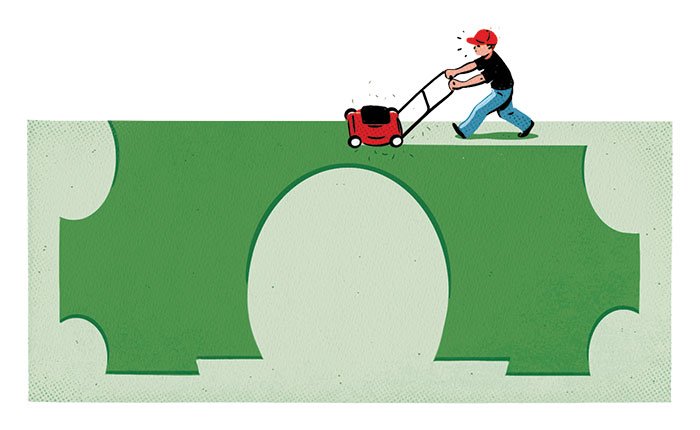
Sometime in the years since my youth, allowances got complicated. When I was a girl—not that long ago—my father would hand my siblings and me a quarter every week or so, and that was pretty much it in terms of cash from dad. Granted, an ice cream cone at the local drugstore cost a dime, so life was simpler. But my parents didn’t fret about whether that small sum was fair, or what lesson they wanted to teach us, or if we should have to make our beds before receiving the money. It was just a quarter.
Today, if you want to figure out whether to give your child an allowance, you can find a cadre of psychologists, academics and financial advisors happy to weigh in on the matter. Whether it’s $10 a week or $100 a month, the modern allowance isn’t just about giving your kids a little spending money. “An allowance can be a very important tool in teaching children about money, if done in a conscious way,” says Don Gettinger, a “capital confidante” for the Glowacki Group, a wealth management firm in L.A. “If done in an unconscious way, an allowance can create a sense of entitlement.”


Gettinger believes that children, starting at about 4 or 5, need to have their own money in order to form good financial habits regarding spending and saving. He argues that parents should never say, “I’ll pay for whatever my kid needs and give him a little something on the side.” That’s giving your child money without meaning. Instead, parents should choose a weekly sum, then decide what it’s for. When the kids are young, maybe they should pay for their extra goodies, like baseball cards, or their own snacks. As they get older, they can pick up their own entertainment and special clothing or electronics. But whatever the purpose of the allowance, parents need to clearly communicate it to their children.
Many parenting experts suggest that a child divide the allowance into three separate accounts—savings, spending and charity. That way she can learn about giving back, buy the inexpensive items she wants and learn that for higher-priced desires—iPads are often mentioned—she must delay gratification. Of course, you have to be disciplined too: “Don’t intercede and buy it, and don’t let grandma and grandpa buy it,” warns Neale Godfrey, chairman of the consulting group Children’s Financial Network.
There is, inevitably, a schism in the allowance debate: Should an allowance come with chores attached? One line of thought holds that children should do what’s asked of them—making beds, emptying the dishwasher, taking out the garbage—without expecting to be paid for it. After all, they’re members of a family and should learn responsibility. That’s not to say that you couldn’t pay your kids extra for, say, painting the basement or washing the car. But routine chores are just that—chores, not jobs.

On the other side are those who say, absolutely, make allowance a quid pro quo for housework. It’s a reflection of how the real world works—you do your job, you get paid (and if you don’t, you don’t). Otherwise, an allowance is just an entitlement program. Godfrey thinks it’s particularly important in wealthy homes to make sure children get paid for doing some chores. Children in such households, she says, “don’t usually get involved in running the household—they have help to do that.” Children of wealthy parents get so many things for free in life; I’m not sure an allowance should be one of them.