

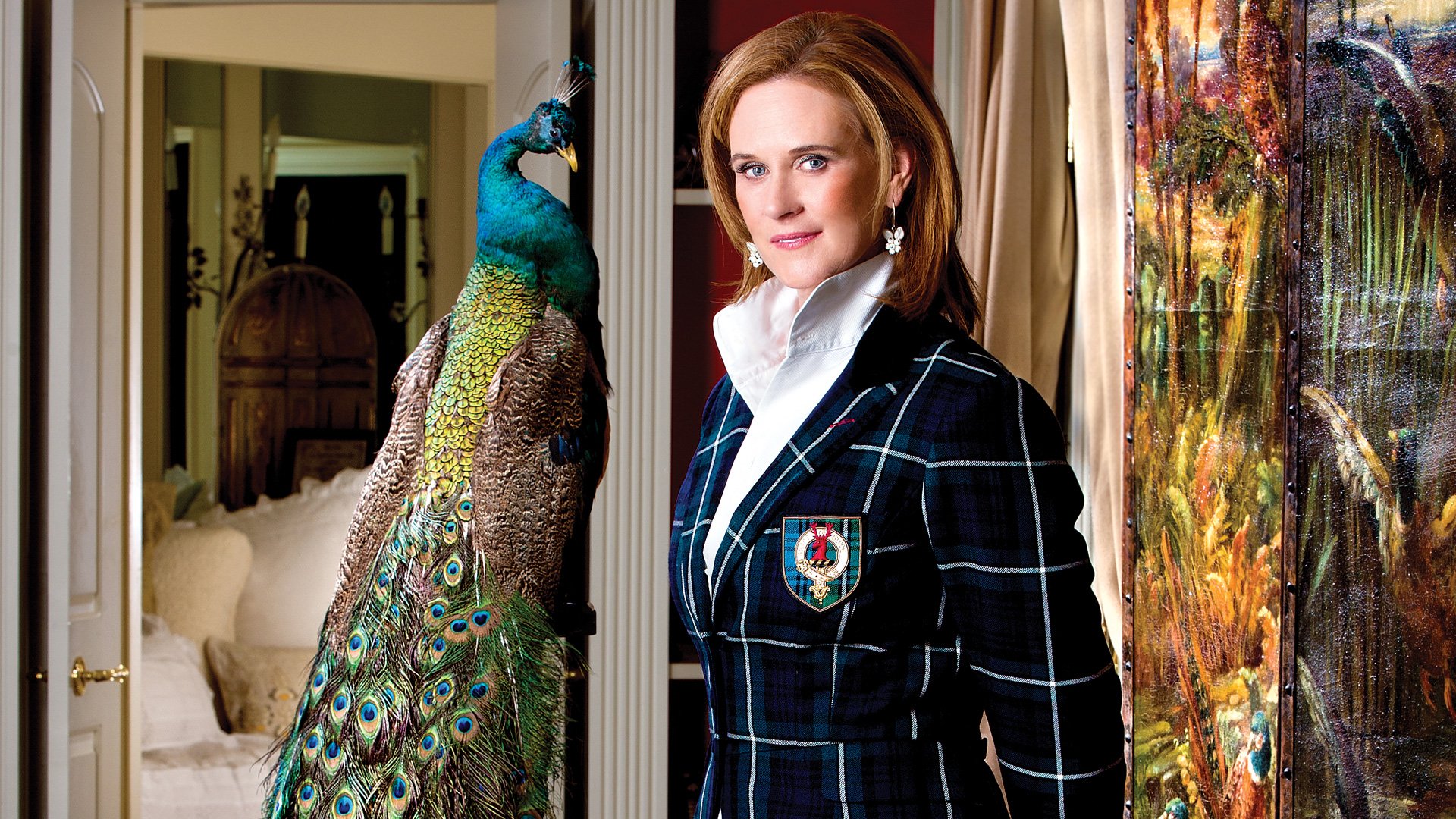
From the start, Sukey Forbes’ middle child, Charlotte, was her most challenging baby. A colicky infant, Charlotte could not sleep on her back or side. And as she grew older, Charlotte was always the child who wanted something different for dinner or an extra story at bedtime. Yet Charlotte also seemed to possess wisdom beyond her years. When she was old enough to write, she scribbled stories that always ended with the same single word, alone, on the last page: “Love.”
“Charlotte had a very well-formed personality,” recalls her uncle and godfather, Jamie Forbes. “She’d developed this premature sense of self that, in retrospect, is a bit haunting.”
When Charlotte was 4, doctors informed Forbes, who now runs an interior design firm, and her husband, biotech entrepreneur Michael Bigham, that their daughter suffered from a rare genetic disorder called non-triggered malignant hyperthermia. The syndrome can cause muscle cells to metabolize too quickly, leading to high fevers, shortness of breath and, sometimes, cardiac arrest. There is no cure for it.

“In my family, self-control was highly valued, and there was a real shame to not being able to get ahold of ourselves emotionally,” Forbes says.
On August 18, 2004, Charlotte, then 6, woke with a scorching fever. As Forbes recounts in her powerful new memoir, The Angel in my Pocket, she rushed Charlotte to the emergency room in their town of Weston, Mass. Soon after they arrived, Charlotte began to twitch and grow rigid, and her temperature spiked to 108 degrees. When a resident came to administer medicine through an IV, Charlotte called out, “I want my mummy!” It was the last thing she ever said; Charlotte died six hours after her mother first touched her feverish forehead.
In the long and agonizing months that followed, Forbes alternated between holding herself together for her family and worrying that she wasn’t grieving properly. A concerned friend introduced her to Stephanie Warburg, who had lost a son to leukemia and ran support groups at the Dana-Farber Cancer Institute. But Warburg didn’t send Forbes to a support group or grief counselor. “I told Sukey, ‘If you can believe you will see your child again, it helps enormously,’” she recalls.
Warburg recommended that Forbes visit a medium, someone Warburg knew, who claimed to mediate communication between spirits of the dead and the living. Forbes was skeptical, but she agreed to attend a public session with the woman at a Holiday Inn in Worcester, Mass.
What happened that night would change Forbes forever. “I got a glimmer of how it might be possible to reconnect with life,” she writes, “and that life could be worth living again.”
Born in 1965, Suzanne “Sukey” Forbes grew up in old family houses in Milton, Mass., and on the 7,000-acre, Forbes-owned island of Naushon off Cape Cod. Her family and its history were central to her childhood. Her ancestors include railroad magnate John Murray Forbes and philosopher Ralph Waldo Emerson, who was Sukey Forbes’ great-great-great grandfather. Forbes’ mother, the former Nathalie Saltonstall, came from a New England family whose pedigree, if not wealth, exceeded that of the Forbes side.
Self-reliance wasn’t just an essay written by Forbes’ great-great-great grandfather, it was part of the family DNA. Her father, Ralph Forbes, had been raised by his aunt and older sister because his mother suffered from bouts of mental illness. When Forbes was 12, her father handed her a set of keys to the family car, a green Volvo with rust holes in the floor, and told her, “You’ll figure it out.” Forbes’ mother would take the kids on salvage expeditions to the town dump; Forbes remembers the thrill of finding a red bike missing only one bumper. The family would fix leaky toilets with duct tape, and the children’s clothing was kept in a single dresser in the laundry room, where the kids would fight over who got to wear which T-shirts and underwear. It was all considered character building—“CB” for short.
But all that pragmatism did little to prepare Forbes for the emotional upheaval of Charlotte’s death. “In my family, self-control was highly valued, and there was a real shame to not being able to get ahold of ourselves emotionally,” Forbes says now. “Tears, anger and joy were to be avoided, because passion could lead you to crazy places.”
“I never saw Sukey cry in those first several days,” says Forbes’ brother Jamie, who was at his sister’s house the day Charlotte died. By contrast, Forbes’ husband, who hails from a large Catholic family, had no problems accessing his emotions. While Sukey remained locked in a tight-lipped grimace, Bigham “would sob and wail,” she says.
Forbes sought more private ways to express her grief. Soon after Charlotte died, Forbes was cleaning her daughter’s bathroom when she discovered a small plastic angel with velvet wings perched on the back of a high and otherwise empty shelf. Figuring that Charlotte had put it there, Forbes began carrying the angel with her—she found it comforting.
She had it when she went to the Holiday Inn in 2006 to see the medium, whom Forbes refers to only as “Margaret.” The woman singled Forbes out from the crowd and told her, “I’m getting a girl. She’s about 7 years old. She died very suddenly….” Margaret paused and added, “She wants to acknowledge something you carry in your pocket all the time. It’s sort of white and sparkly.” Forbes reached into her pocket to feel the plastic angel. “She says she put it on the shelf for you to find,” the medium said. Forbes burst into sobs.
“As the tears streamed down my face, the logical, Episcopalian part of me kept struggling, still resisting the idea and wondering if I was being hoodwinked,” Forbes writes. “But as for the angel—I’d never even told Michael about it. I hadn’t told the kids. No one on the planet knew about that angel I carried in my pocket but me…and Charlotte.”
Forbes walked out of the Holiday Inn and immediately booked an appointment with Margaret. Bigham came with her to the session, where Margaret would channel messages from Michael’s two deceased uncles, Sukey’s grandfather and, finally, Charlotte. Margaret mentioned a plastic cluster of daisies, white with a yellow center, planted by Forbes’ son, Cabot, now 17, in Charlotte’s memory. “That’s true,” Forbes said, “but they’re blue with a yellow center.” Margaret said, “I’m getting that they’re white.” When Sukey got home, she saw that she’d misremembered—the daisies were white. “Margaret—or maybe I should say Charlotte—had it right.”
Forbes never saw Margaret again after those two meetings; she was convinced that she could now connect with Charlotte’s spirit without the aid of an intermediary, and in time, she would. Most important, she felt peace.
Charlotte, she believed, was happy and safe. And one day, Forbes knew, she would see her daughter again.
In time, Forbes would start an antiques and decorations business that she still runs. And in 2007, Forbes and Bigham founded the Charlotte Saltonstall Bigham Memorial Fund, which makes annual contributions to causes that might have appealed to Charlotte. But in 2010, six years after Charlotte’s death, Forbes and Bigham divorced. “The inner core that makes a bond seem natural had begun to dissolve in our very different responses to grief,” Forbes explains. The two now live around the corner from one another in Weston so that the children—Cabot is now 17 and daughter Beatrice 13—can go back and forth between their parents’ houses.
Long a journal writer, Forbes says, “I made a promise to myself that if I ever found my way back to a fully expressed life that I would write about the experience.” With The Angel in My Pocket now nearing publication, Forbes knows that not all her friends and readers will buy her story. “I’m curious how it will play out,” she says. “I’m a rational, thoughtful person, and I went into it with open eyes, and I met people who had the ability to contact the other side. That connection has given me a great level of comfort. If someone chooses to dismiss it, they can. But that truly was my experience.”