
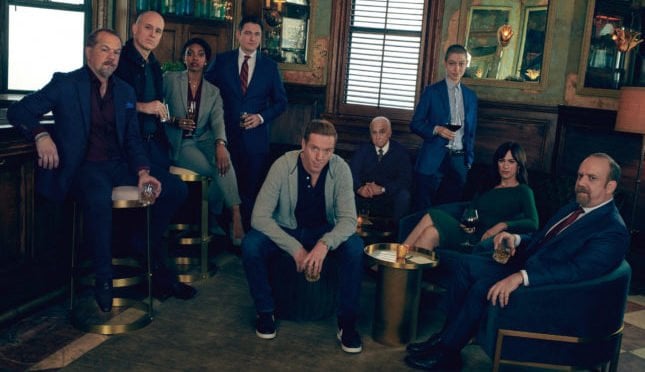
The world of Billions can often seem to be an exaggerated version of the one that we all live in and know. For New Yorkers or those who work in the financial industry, the overlap can seem almost freakish—that guy that you just saw on CNBC or had lunch with or who helped broker a jet for your buddy just popped up on-screen. The show, which concluded its fourth season in June, has become known for its cameos by Wall Street and wealthy elites, from Wheels Up CEO Kenny Dichter to Avenue Capital’s Marc Lasry.
It’s a world without honor yet with its own code of conduct, one nobody dares to break unless they’re the most powerful player at the table. It’s not just that hedge fund manager Bobby Axelrod (Damian Lewis) and New York State attorney general Chuck Rhoades (Paul Giamatti) do whatever they want; it’s that there’s so much they can do. Those around them are forced to respond in one of three ways: One, step aside. Two, fight back (but you better win). Or three, pit Axe and Chuck against each other.

When Billions premiered in January 2016, it felt like a dramatization of the insider trading clash between SAC Capital founder Steve Cohen and U.S. attorney for the southern district of New York Preet Bharara—with, presumably, more sex. In between Bobby Axelrod and Chuck Rhoades was Wendy Rhoades, Chuck’s wife and the in-house therapist and performance coach at Axe Capital. The love triangle, Chuck’s predilection for S&M and the raw use of power and influence gave that first season a sheen of melodrama. Critic Heather Havrilesky, writing about the first season in the New York Times in January 2016, said that “the show…careens into cartoon territory almost immediately, thanks in part to the absurd contrast between Axelrod and Rhoades.”

Billions may have been—may be—over the top. Television is not for the understated. But weren’t creators David Levien and Brian Koppelman actually channeling the raw forces that make the financial world spin? In a real world full of billionaire hedge fund managers, consiglieri attorneys to the president, pyramid scheme-building financiers and duplicitous Russian oligarchs, was anything in Billions really that implausible?
As it’s turned out, there are times when Billions is actually less dramatic than current events. Season four opened with Axelrod’s number two, Mike “Wags” Wagner, attempting to close a deal with an Arab sheikh. Things go sideways, though, when he visits the consulate and several thuggish characters quickly snatch Wags and disappear him into a hidden room. It’s hard to watch the scenes now and not think about the savage murder of Washington Post columnist Jamal Khashoggi by agents of Saudi crown prince Mohammed bin Salman. But it wasn’t art imitating life; Koppelman and Levien wrote the episode before Khashoggi’s death.
The show now seems to be in a sort of real world feedback loop, creating the reality it then portrays. It feels pretty real when the actual New York Stock Exchange president Stacey Cunningham introduces Wags on the steps of the actual New York Stock Exchange to announce a fictional boxing match between two fictional portfolio managers, and the fight itself is sponsored by the fictional Axe Capital and the real private jet company Wheels Up. The only way to make sense of this hyperreal world is to break it down to its components, its two key inputs and outputs: money and power. In Billions, just as in the market, you’re either up or you’re down.
Worth caught up with Billions creators and executive producers Levien and Koppelman at the close of season four. Here are their thoughts on money, power and the world of Billions.
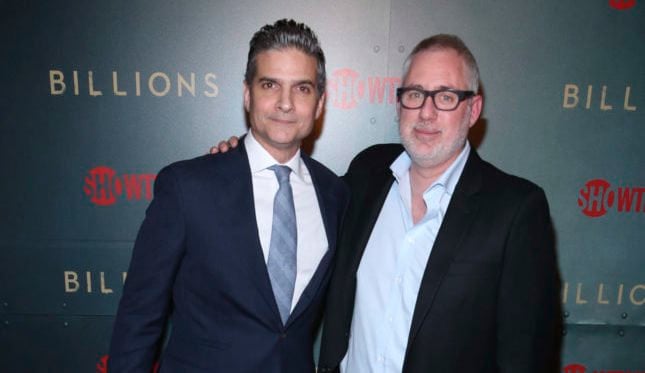
Q: I’ll cut to the chase. Are all the characters in Billions either sadomasochists or sociopaths?
Brian Koppelman: The answer is no. That is a hard no. I mean, the pursuit of power…Power is a fascinating word because there are so many different ways in which the pursuit of power manifests, and then there are so many ways that one can use power, right? One can use power for absolute good or for absolute bad. But most of the people we study, and are interested in portraying, use it for something in the middle. Sometimes for their own uses, sometimes to help other people, sometimes to access that which no one else can access.
And therein lies the drama, right?
Koppelman: We’ve talked to these people [in this world] and listened to them. Although all our characters are fictional, a lot of what we’re doing is reporting ahead of time on the ways in which power is deployed. So that could be the power that an emir in an embassy has. It could be the power that a hedge fund manager has to destroy a company or a market. It could be the power that a sports team owner has to do something great for a city or bad for a city. We’re listening and watching and then, without judging it, trying to show it.
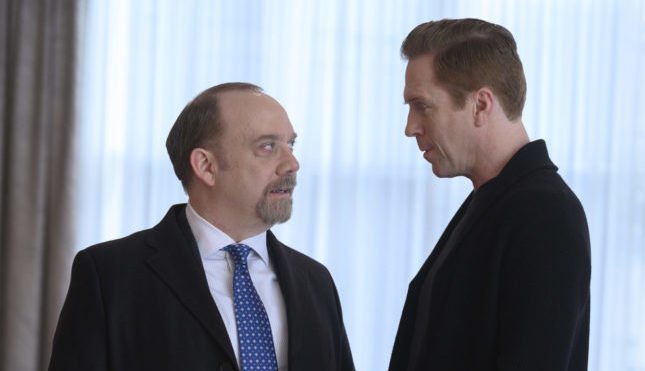
David Levien: Chuck Rhoades was one of this subset who would want to run for office or get appointed to an office that gives them great governmental power. We saw in many of these guys a deep-seated belief that they knew what was right, and they planned on doing what was right for the greater good, if only they could get to that power of decision. Along the way they reconciled doing things that were not good at all.
As opposed to Bobby Axelrod, whose power comes from his enormous wealth.
Levien: On the other side there was a guy who accrued this great wealth at a fairly young age, and all the influence that it brings. He started to feel that these laws of men didn’t apply to him because they were made by political functionaries and people with agendas, and he was in this pure marketplace where small concerns were beneath him. And now these two people are on a collision course.
In the course of writing the show, did you meet a lot of the real-world prototypes for these characters?
Koppelman: Very early on, we realized through having these conversations and studying these people that some of them were really interested in reminding you, “Sure, hey, I could crush you. I have all the power. I’m going to win.” But some of them wanted a kind of freedom.
Somebody I like a great deal is [Avenue Capital cofounder] Marc Lasry. First of all, he does a ton of good for people. But also, he’s thinking in terms of freedom and experience: “How can I look at the world and figure out what would be a great thing to be able to do?”
And he’s able to do it where other people can’t.
Koppelman: Exactly right. You can look at this lots of different ways. A few people have told us stories about taking their friends on some crazy trips, like the Metallica episode. [In season one, Bobby Axelrod takes his old friends on a VIP trip to see the band.] Someone could watch that episode and think, Wow, this guy really needs to win every interaction.
You can think, Well, Axe has to show these guys, “You can go to Metallica on my plane, under my terms,” or you could think, What a generous guy. He’s bringing his friends who couldn’t otherwise do this. They’re getting to hang out with the band, and it’s not about him at all.
So much of it has to do with your ideas about money and power and influence. What do you think is right or wrong? If you’re somebody who thinks all billionaires, by definition, are bad, then every action will look bad to you.
But if you think you’re somebody who believes capitalism is the ultimate meritocracy, then maybe you think, Well, these people won at that game.

You’ve crafted the show very carefully so that anytime one of the characters—whether that’s Chuck or Bobby or Taylor—thinks they’re winning, there’s another, bigger threat just around the corner. There’s always someone who’s just as powerful, or maybe a bit more powerful than they are.
Levien: Our show is about powerful people, but in general in drama, your characters need obstacles and challenges. If our characters were omnipotent, it would be very boring. The challenge is coming up with stuff to make them retain their power in a realistic way by constantly having them butting up against other forces. We don’t believe that the world is a place you can just smoothly sail through once you reach an income level.
Just think about that thing that happened with Jeff Bezos. The richest man in the history of civilization basically was getting blackmailed and had to do something completely uncomfortable. [In February, the National Enquirer was threatening to publish compromising photos and texts if the Amazon founder didn’t cease funding an investigation of the publication. Bezos called its bluff.] It wasn’t easy for him.
Koppelman: That was maybe the most remarkable demonstration of power I’ve seen in the last five years. Bezos is so powerful that he could say, “Yes, I did this,” and admit something that most people would not only be loath to admit, but if they admitted it, it would destroy their company’s stock. It would destroy their position. But his power is so great and untouchable that he was able to own it.
It’s not unlike the scene in season four where Chuck outs himself as a sadomasochist during his campaign for New York attorney general.
Koppelman: We wrote and shot Chuck’s speech months before Bezos. We were trying to understand the calculus of how somebody would do that.
Levien: We realized that certain people in positions of great power can push the window of acceptability more than even a great mass of people moving in that direction.
Koppelman: We very rarely use the word power with each other, or use it in the writers’ room, because we assume these people have that power, and then it’s their own human characteristics that determine what they’re going to do with it. There are some hedge fund managers who, when they’re having a particularly bad period, would be scared that they would lose their position and influence if they owned their mistakes in a letter. There are others who would decide, Well, the source of my power comes from people thinking I’m the smartest, most open of the hedge fund managers.
We’re really interested in the ways in which people in difficult circumstances strategize about holding on to their power.
So I’m going to put it all out there.
Koppelman: So I, in order to deploy my power, have to say in a letter to my investors, “Here’s the thinking that went into me screwing up, here’s the way I’m thinking going forward. Stick with me or not, but know I’m still the same ruthlessly honest, rigorous person.”
Levien: Versus the tycoons who like to do the omniscient thing where they just explain the circumstances and how they’ll just end up being right later.
Koppelman: We’re really interested in the ways in which people in difficult circumstances strategize about holding on to their power. Most of the time, these people can just use their power in a fairly effortless way. The only times they really think about where it lives is when they might lose it. So in our show, these characters are always on the precipice. Something’s always threatening their place and their position.
And are you drawing on real examples for inspiration there?
Koppelman: In the last bunch of years that’s really the case for a lot of hedge fund managers. Also, look at Preet Bharara when he was U.S. attorney. The new administration comes in [in January 2017], and he’s told he keeps his job. It’s a moment where you think he has great strength, and then he’s kneecapped and he’s out. We’re interested in: What does that guy do now?
Has the reception to the show changed since the election of Donald Trump as president? Do people think about power differently?
Koppelman: When the show started, people might have thought it was hyperreal. Now people know we’re not overselling it at all.