
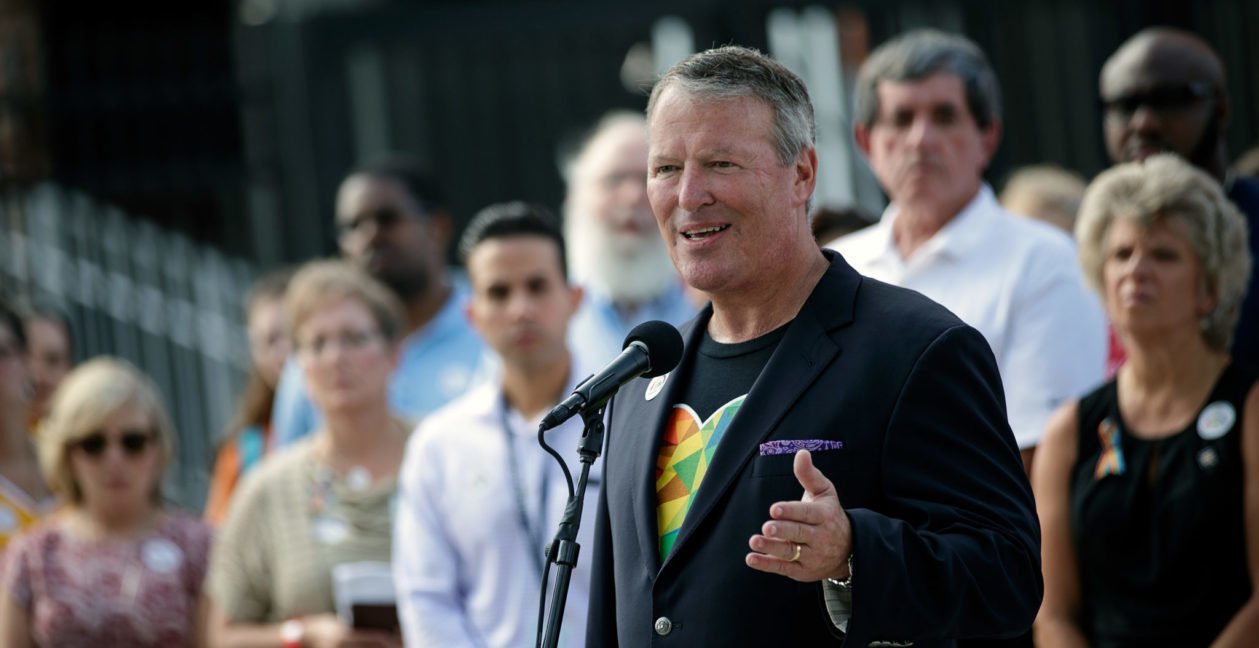
The midterm elections of 2019 garnered massive media coverage for certain watershed events, like the Democrats taking control of the Virginia legislature and a Trump-supported Republican losing the gubernatorial race in Kentucky. One race that didn’t get much national attention was the reelection of Democrat Buddy Dyer as mayor of Orlando, Fla., Dyer’s fifth term as mayor. Dyer won with an overwhelming 72 percent of the vote.
The media’s focus on statewide races with national implications was understandable, but Dyer’s race also had national import: For one thing, it showed how just how much voters like it when politicians get things done. It also hinted at just how much good news there is in American cities, one of the country’s great under-reported stories.

Dyer, who grew up in Kissimmee, Fla., and attended Brown University and the University of Florida College of Law, served in the Florida state senate for a decade before winning his first mayoral race in 2003. He came into office as a reformer with big plans: invigorating Orlando’s downtown—something many tourists don’t even know exists—through the construction of a new performing arts center and a new arena for the Orlando Magic, and the renovation of the aging Citrus Bowl. Almost 17 years later, those projects will have come to fruition when the second half of the beautiful Dr. Phillips Center for the Performing Arts opens in 2020. Dyer has also helped to facilitate the expansion of the University of Central Florida (UCF), which has become one of the country’s biggest universities, and the creation of Lake Nona Medical City, an ambitious, 650-acre medical complex within the new, 17-square-mile, mixed-use community of Lake Nona. More recently, Dyer has overseen the creation of Creative Village, a 69-acre hub of tech, education and housing in the heart of downtown Orlando. In the process, Dyer has consistently pushed for inclusive economic development, especially for the largely African American and economically disadvantaged neighborhood of Parramore.
Dyer, whom I’ve interviewed several times, is a low-key, quiet man whose steady demeanor belies the passion he has for his city. He gets most animated when talking about policy—housing, transportation, infrastructure, economic development—or Orlando’s emergence as a progressive, tolerant and growing city. As he said in the context of public housing during our conversation, these are not “sexy” topics. But his work on them over the past 17 years has delivered enormous benefits to the residents of Orlando. At a time when national politics is full of shouting, Dyer’s quiet work has produced enduring results.
Q: Congratulations on being elected to your fifth term. This was clearly not a vote for change—what was your argument for why you deserved another term?
A: (Laughs) I ran on “more of the same.” Talking about everything that we have done from the sports and entertainment venues to Medical City and UCF, Creative Village, downtown revitalization, what we’ve done in Parramore. But we still have a lot to do, and I was more energized and excited about running for office this time than I was in 2003, when I first got elected.
That’s a good sign, but it’s a little hard to believe. What makes you say that?
In 2003 I got encouraged to run and had no idea what I was getting into. Today I know exactly what I’m getting into. We have a lot to work on including affordable housing, homeless issues, transportation infrastructure… I feel like we have great momentum, and we’re going to be one of the great cities of this century.
Can you talk about the difference between that 2003 campaign and this one?
The first time, I had just come off an unsuccessful run for state attorney general against a guy named Charlie Crist. [Crist would go on to serve as Florida governor and is now a member of the U.S. House of Representatives.] In December Jeb Bush, who was governor, had appointed Glenda Hood, who was the mayor of Orlando, to be Florida secretary of state, and right after that the city council called a special election for, like, six weeks later. There were already seven people running. A bunch of people started telling me I needed to run for mayor. I might have been in City Hall one time, ever.
So what made you decide to run?
One morning at about 6:30, the pastor of the largest African American church in Orlando called me and said, “We’ve just spent the last hour praying about you running for mayor and we think you should. Because you’re the only person we can think of that can walk the walk for both the business community and the African American community.”
When you get that call, it’s kind of compelling.
So that was the tipping point for your decision?
I got in and was the immediate leader—I had represented 90 percent of the city in the state senate for 10 years—and we ended up in a run-off, and we won the runoff. That race was old Orlando versus new, progressive Orlando, and I was new progressive.
What have you learned about being mayor that you didn’t know back then?
Everything. I like to joke with everybody that I had a steep learning curve—it’s taken me 16 years, but now I can give you a good four years. I think being in the senate helped me a lot, though—learning the art of compromise and collaboration.
You’re not a fire-breathing, divisive character.
I’m more of a consensus-builder.
At the national level, American politics has been swinging from left to right and back again—Bush to Clinton to Bush, Obama to Trump. But this election was really a referendum on the premise that it’s good to have sustained leadership. How does Orlando benefit from having a mayor who’s served four terms?
A lot of the things we’ve done, you have to have sustained effort to get done. We’re doing a lot of affordable housing that has been years in the making. It’s not sexy, but it’s an issue that has to be addressed and it can’t be done overnight. We didn’t break ground on the performing arts center till year nine of me being mayor, so if I’d have had term limits after eight years, who knows if we would have gotten there. We’ve been working on Creative Village for probably 15 years.
Creative Village is a downtown project that might surprise people who, when they think of Orlando, think only of Disney World and Universal Studios. How did that come about?
That area was once the Central Florida fairgrounds—a building there that is now part of the UCF campus had been the livestock pavilion. And about 2005 [digital video game company] Electronic Arts came to us and said that they wanted to expand, but they were concerned about the talent pool that they had. So UCF stepped up and created the Florida Interactive Entertainment Academy, and we leased that building to them for a dollar a year. It’s a graduate program for gamers.
The UCF campus is a big part of Creative Village, but there’s also residential and student housing, studio and retail space, office space… How did all that come about?
In 2008, when it became clear we were going to pass the venues plan, we were going to be able to demolish the old arena, so we then had 69 acres that the city owned that we were going to be able to redevelop. Not many cities get an opportunity to redevelop 69 acres in the heart of the downtown. So we did it very deliberatively. We put together a stakeholder group to think it through, and the concept was to have a creative cluster in digital media, emerging media, because we had had great success with industry clusters in simulation and training, hospitality, biomedical life sciences. We went out and did an RFP for a development partner and got a local one, and we started on the infrastructure. We got a TIGER grant [Transportation Investment Generating Economic Recovery, part of the federal government’s 2009 stimulus package] to straighten out some of the roads and extend the LYMMO [bus] system into that.
How did UCF, whose main campus is in east Orlando, become part of the project?
In 2011 Dr. [John] Hitt, who was president of UCF, was meeting with a group of presidents from bigger colleges and became enamored with what Arizona State was doing—their main campus is in Tempe, but they had built a downtown campus in Phoenix. So, with UCF and our development partners, we went out for a visit. After that, we crafted a deal to bring UCF downtown, as well as Valencia College. And coincidentally right next door Orange County Public Schools built a K-8 school that they called an ACE school—Academic Center for Excellence. So you’ve got all that synergy between the K-8, the community college, the university, and then there’s a law school [the Florida Agricultural and Mechanical University College of Law] right around the corner.
It’s basically one-stop education—all you need is a high school.
Well, Jones High School is not far from there.
So that’s an impressive continuity of education, all in downtown Orlando.
Yes. And at the ACE school, Harris Rosen, one of the hoteliers here in Orlando, funded a program so that they have free pre-K. And if they go all the way through and graduate from Jones, he scholarships them to college. Pretty cool. So you can grow up now in Parramore and grow up and get quality child care at 2 years old and [ultimately] go over to Jones, then come back and go to Valencia and UCF, and then go to law school, and then have a job right there too.
I think everybody’s proud that we’re a community that embraces diversity and inclusion.
Over the past several years, you and I have talked a lot about Orlando’s identity and the fact that it’s much more than just a place people go to visit theme parks—that Orlando is a city with a vibrant downtown, where people raise families and where young people have stopped moving away but are in fact moving here from elsewhere. Part of that discussion, tragically, was about how the mass shooting at Pulse nightclub in 2016 prompted an outpouring of community support. How has Orlando’s identity evolved since that time?
I think everybody’s proud that we’re a community that embraces diversity and inclusion. We’re one of the more LGBTQ-friendly communities in the country, and we’re known for that. We are also an international city that is a melting pot. About 20 percent of our population wasn’t born in the United States. And then the other thing that we’re really getting known for is becoming a green city. We’ve really doubled down on sustainability.
Can you give me an example?
We’ve done pilots with floating solar [energy panels]. We have a lot of water bodies, so rather than take up green space with solar, we’re looking at where we can deploy floating solar. I sit on the board of Orlando International Airport, and we have a contract to do floating solar out there. One of the reasons I want to do it at the airport is because I’m envious of Denver. When you drive into their airport, you see just a huge array of solar. We’re going to put this in an area that you’ll see from the People Mover when you’re coming in. So it’ll just scream at you that Orlando’s a green city.
You’re also spending about $3 billion to build a new terminal at the airport, which, frankly, I always find a little underwhelming, given how many people come to visit Orlando. It’s crowded, and the security lines are long.
Yes. We’re the 10th-busiest airport in the United States. The [main] terminal was originally constructed for 18 million passengers a year, and we’re at almost 50 million now. The new terminal is going to be fantastic—this will be an iconic airport. It’ll be state of the art in every sense—the technology, the art. We’ll have a non-gravity baggage system, so your arrival will be on the upper concourse rather than the lower concourse. Just about every airport you go to, you come in at the top and then you exit in the basement, basically. So your first impression is not generally a good one. We’re able to reverse that. And what’s also cool about it is, it’s a true multi-modal center—bus, car and train. Brightline, Virgin’s fast train, is going to come into that terminal.
But from downtown Orlando, you’d still have to drive or take a bus to the airport?
The [Orange] county mayor, Jerry Demings, is proposing a sales tax initiative for 2020. If that occurs, we’ll probably have the resources to take our commuter rail to the airport. So when you come here, you’d be able to walk over to Church Street [in downtown Orlando], take the SunRail to the airport, and then get on Brightline and go to Miami in three and a half hours.
You’ve clearly been looking at some of the best practices in other cities.
We’re always doing that. Whatever we happen to be working on, we try to go to a city that has done it well. So we went to Houston for a homeless best practices mission, we went to Pittsburgh when we were doing rail stuff. When we were doing biomedical, we went out to San Diego.
Given the dysfunction in Congress and the White House, it’s encouraging to hear such openness to ideas from other places.
Cities are where everything’s happening now. Not at the state, legislative, and certainly not at the federal level. I think an interesting angle is to look at the philanthropy in different places. I went to Pittsburgh last year and they have, like, five different philanthropic organizations that have over a billion dollars’ worth of assets. And then they have another half a dozen that have between half a billion and a billion.
Orlando has an engaged philanthropic community, but not on that scale, right?
The largest not-for-profit organization we have, Dr. Phillips, is between $300 million and $400 million. [The Dr. P. Phillips Foundation was founded in 1953 by the family of orange juice mogul Philip Phillips.] But you look at Pittsburgh, and their money is from the robber barons of earlier eras. Then you go to Dallas and Houston, and it’s oil money.
I just think it’s an interesting angle—who are the people that are large philanthropists in different communities, where did the wealth come from, and if you don’t have it, how do you as a city make up for it?
In Orlando’s case, what’s the answer to that question?
We make up for it by having the largest collection of tourist development tax in the country. So we funded our performing arts center [the Dr. Phillips Center for the Performing Arts] and our arena [the Amway Center, where the NBA’s Orlando Magic play] and renovations to the Citrus Bowl [now Camping World Stadium]. And now we’re helping our ballet and philharmonic, the Holocaust museum and the science center, by using the tourist development tax, which replaces the lack of philanthropy.
Why does Orlando not have that level of philanthropy?
We just don’t have the old wealth. Here, it’s largely new money. Pittsburgh really illuminated that to us when we were there. They’ve done a nice job revitalizing their downtown. Now, instead of being a coal-steel city, they’re a city of innovation. They really are. With Carnegie Mellon leading the way.
American cities are full of exciting innovation, but you don’t hear much about any federal role—the Trump administration has largely abdicated any meaningful role in our cities.
Absolutely. And the other dynamic is there’s a lot of red state legislatures and a lot of blue cities. The legislatures are spending a lot of their time trying to preempt our ability to do certain things. So somebody like a large supermarket chain, for instance, if we want to do anything like saying, “We don’t want to have plastic bags,” they’ll just run to the legislature and preempt us from regulating in that area.
That happened?
Yeah.
That was Publix?
Yeah. Or straws—we can’t regulate in the area of straws. We did it for city facilities, banned plastic straws and plastic bags. But we can’t do it on a citywide basis.
Is the same true for setting the minimum wage?
We can’t do a minimum wage—not citywide. What we have done is established what we call a living wage for our employees and people who contract with us.
This is not just about the tensions between mayors and legislatures, right? It’s also about the tension between progressive, economically healthy cities and rural areas that are more culturally conservative and less economically successful.
The other thing that I’ve been harping on lately is that the 10 largest counties in Florida, the 10 urban counties, provide about 70 percent of the state’s revenue, which we share with the other 57 counties. Ten blue counties provide the largest percentage of the state budget. And yet the other counties are always trying to inhibit what we think are the things we need to do to create economic vibrance. “We don’t want those progressive blue mayors to be successful.”
Looking forward, how do you pace yourself, after 16 years of being mayor?
I have a really good staff and I’m pretty good about empowering them to do their jobs. What I’ve done over time is find people who can take the small stuff off my plate. It gives me the opportunity to do the bigger thinking.
I know you keep a busy schedule—how many nights a week are you out these days?
It’s a matter of what we accept—I could be out every night. But I’ve been here long enough that we’ve learned to say, okay, the heart association event, I can do next year, and this year we’ll do the cancer event. We don’t have to do everything every year. What I try to do in the evenings, though, is if I’m doing an event, I’ll do a couple or three, since I’m going to be out anyway.
Those events are a lot of work, I assume—as the mayor, you’re always on.
I don’t ever go anywhere without having to speak. But I always make them let me speak before dinner, so I can just skip out. I went to one event recently where I didn’t have to speak, and I was like, oh my God, this is so cool—I don’t have to speak!