
Michael Dorf likes a challenge. At 23 years old, he started the popular Knitting Factory concert space in New York—and made the rustic ceiling cool by covering it with sweaters he purchased at Goodwill for $1 each. After selling his stake in 2002 in what had become that multimillion dollar enterprise, he had another dream: to create a bonded winery/concert venue/upscale restaurant in an urban environment that captured the conviviality of evenings usually only experienced in locales like Napa. In 2008 he opened just that: the first City Winery in Manhattan. The “custom crush” facility, as it’s been called, was a smash. Next came perhaps the biggest challenge and one that endures. How to make City Winery into a multi-location business—Dorf has expanded to fifteen venues in eight cities, with more on the way—without losing its soul?
One trick is to take advantage of the Winerys’ economies of scale, offering perks like state-of-the-art Meyer sound facilities and multi-locale contracts to artists, but never stop devoting attention to the details that make each Winery unique. “The last thing we want to be is the McDonald’s of live music,” he says.

To make sure each Winery is a fit for its locale, Dorf treats the choice of cities as an art. “I use a lot of gut instinct and conversation in decision-making, more than I do economic ‘heat maps’ and the empirical data,” he says. In addition to gauging an area’s quotient of wine enthusiasts, “the single most important conversation I have is with the music community.” The latter spans talking with local musicians—City Winery’s Pittsburgh location was inspired by a dinner party chat with late great jazz pianist Geri Allen—as well as agents and managers planning tours for acts like Neil Young and Suzanne Vega.
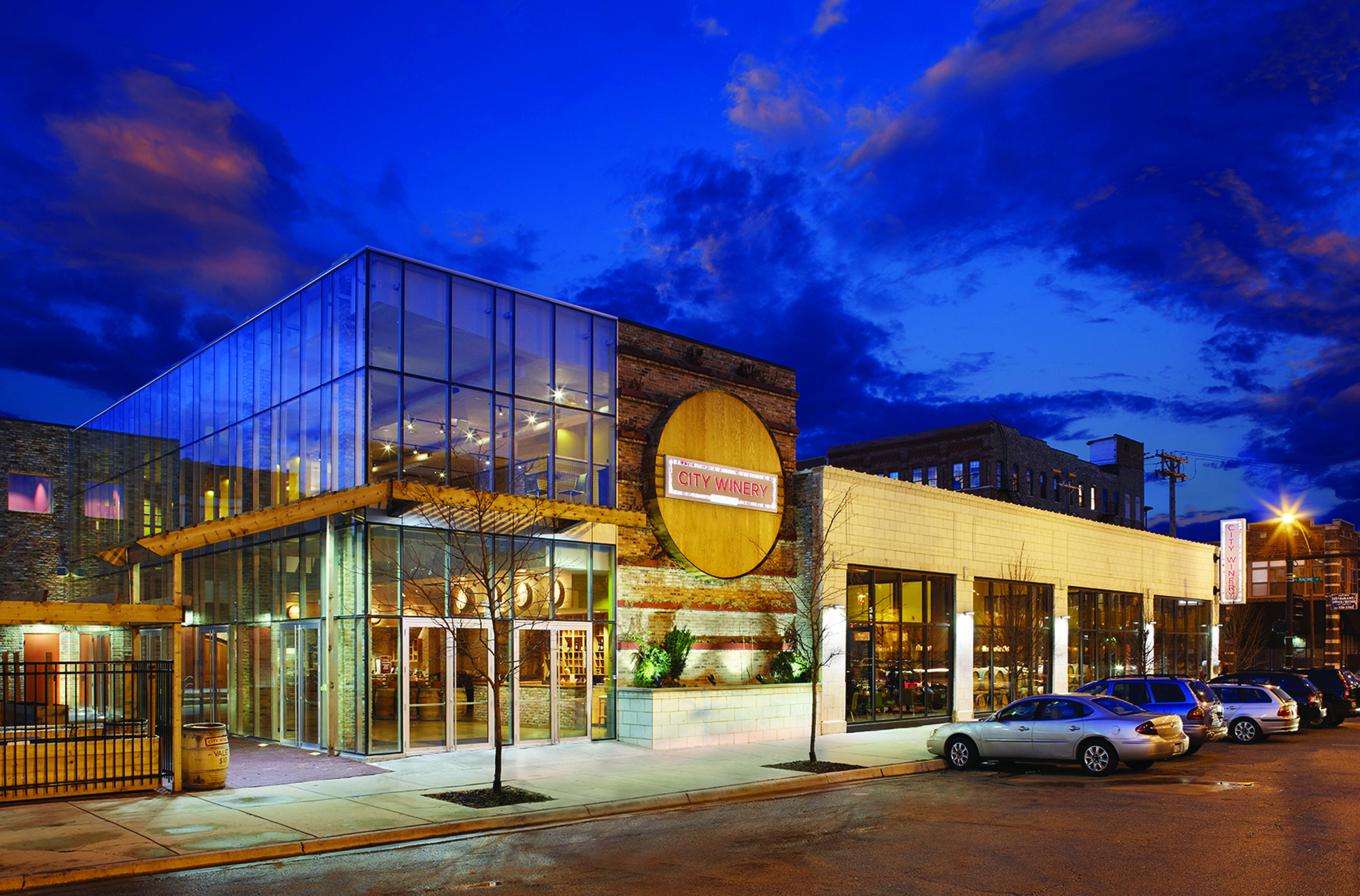
When it comes to choosing neighborhoods Dorf likes to go rogue a bit too, something he says he can do because of the destination-driven nature of concert venues (as opposed to, say, a restaurant which relies on established neighborhoods for things like walk-ins). City Winery Chicago, the second location, set this pattern in motion. “Every realtor and, frankly, several of the local investors suggested it be in a couple of neighborhoods that were traditional entertainment, easy-to-get-to-from-the-suburbs, blah blah blah. It just didn’t feel right. Instead, there was an up and coming culinary area called the West Loop where there was no entertainment, no hotels, only sort of creative restauranteurs.” Dorf bought a former food distribution warehouse at a great price and transformed and updated it in a way that still featured its original red brick and wooden beams. “Those material choices from 100 years ago are almost impossible to recreate in the same ways and at the same quality level today,” he says. He’s employed similar “adaptive reuse” on older buildings in other cities as well. “In Atlanta, we’re in what used to be the Sears distribution center. In Detroit, we have a building that was an old Spanish restaurant from the ‘50s. In St. Louis, we’re literally in a 75 year old steel foundry.”
Coming in to a new city can be tricky when it comes to winning over locals. But Dorf says his businesses create a rising tide that lifts many boats—particularly in the up-and-coming districts where he’s located. Of City Winery’s newest location in St. Louis, Dorf says, “We’re bringing probably at least 100 new nights of music to the city that wouldn’t have happened in 2023. So we’re adding to the pie. And we feel very good about that.” Dorf also makes it a point to hire local warm up acts for concerts, and the restaurants’ “wine-inspired, globally-influenced” menus use locally sourced ingredients. Nonprofits are also often given free event space. When Emmylou Harris held a fundraiser in Nashville for her shelter for elderly and disabled dogs during Covid, Dorf transformed that city’s Winery parking lot into a pandemic-safe venue.
Original touches are part of each Winery, but Dorf notes that certain constants appeal nationwide. Among the things customers appreciate: City Winery’s commitment to making alcohol with as green a technique as possible. The locations make their own wine from grapes imported from California, Washington, and Oregon but, instead of transferring it to bottles, move it from barrels to stainless steel kegs and serve it on tap. As a result, bottle glass doesn’t need to be trucked in from far flung locales and carbon consumption is significantly reduced. There are exceptions. City Winery’s Grand Central Station location offers a grab and go mini-bottle option for commuters, but to counter the eco-effects Dorf created a program offering a $5 refund on a $15 bottle. Dorf describes it as “the first serious reuse bottle program in the country” and hopes other sellers follow suit.
Dorf says all of this detail work serves one goal: to impart a sense of intimacy to a night at City Winery. Particularly in a post-Covid world, Dorf, who is also the author of Indulge Your Senses: Scaling Intimacy in a Digital World, says, “The idea of having a connection with fellow humans—breathing the same air, touching the tables, drinking wine out of a real glass, doing cheers at a concert together …It’s an antidote for all the screens that are in our lives. And if each of those sensory components are working—there’s the magic of live music, good food, great wine and great visuals, it can be a very special moment. That’s what we aim to create.”
City Winerys are located in Atlanta, Boston, Chicago, Hudson Valley, St. Louis, Nashville, New York City, and Philadelphia.
City Winery opens in Pittsburgh June 7th. Columbus and Detroit locations are slated for early 2024.