
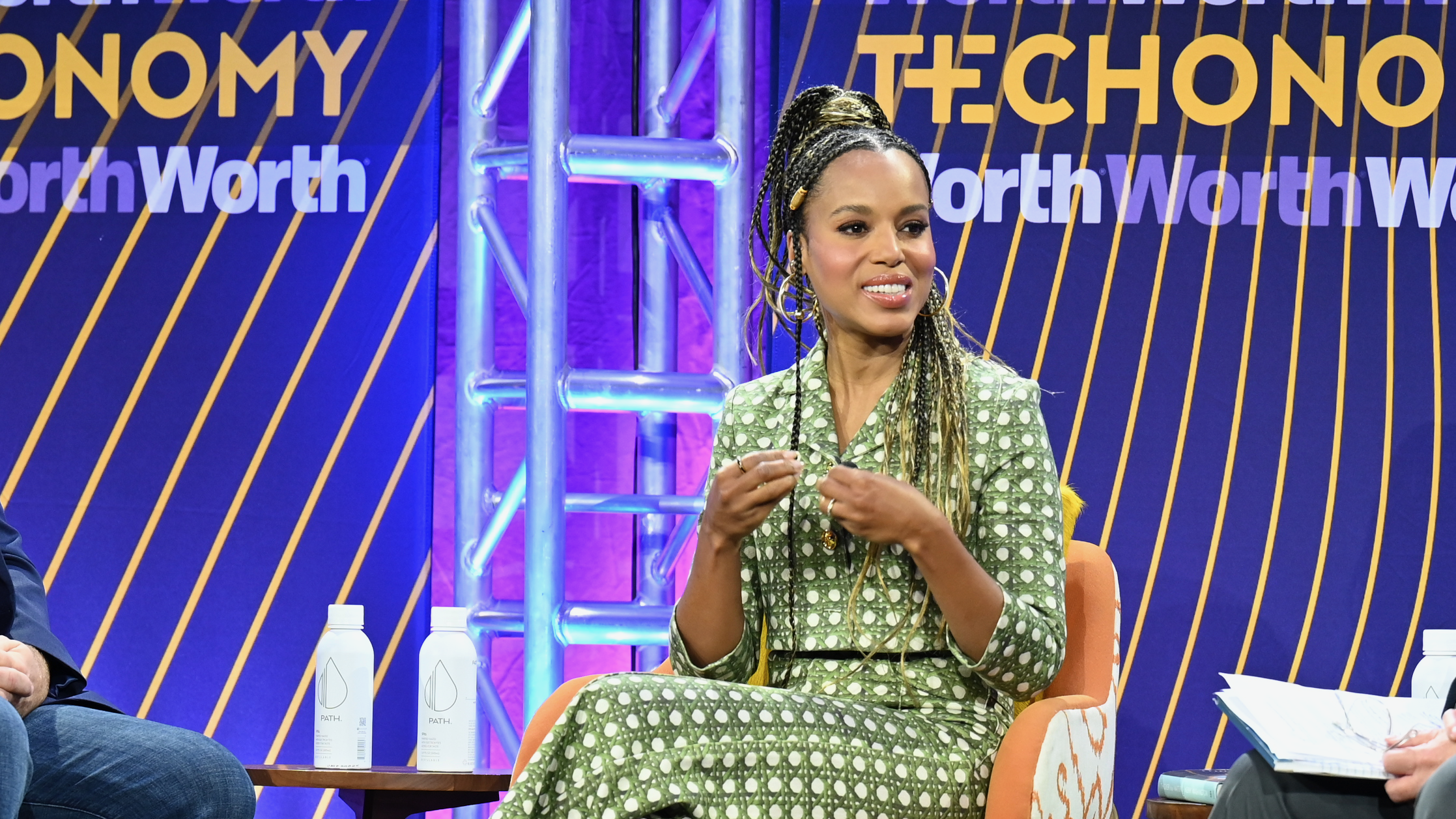
If anyone is capable of diffusing the tension between actors and AI, Kerry Washington is a good candidate. Washington won over legions of fans with her breakout role in “Scandal,” and since then, she’s put her star power to good use. She’s produced documentaries; she’s written a book; she’s started a school; she’s served on Presidential committees; and she’s been a champion for workers’ rights. Now, Washington is grappling with how actors and their representatives could use—or misuse—AI in the coming years.
Washington joined Vermillio CEO Dan Neely and Worth Media chairman Jim McCann at Techonomy 23: The Promise and Peril of AI in Orlando, Florida. Their talk, called “The Next Creative Frontier,” focused on the potential applications of AI in the entertainment space. This topic was an enormous point of contention during the recently concluded SAG-AFTRA strike.
Consent and authenticity
Washington and Neely have been working together on a proof-of-concept AI with her likeness. Her approval, she argued, is what makes the project respectable. To illustrate her point, she reminded the audience that her “Scandal” persona, Olivia Pope, was famous for carrying stylish Prada handbags.
“Now you can go down to Canal Street [in New York City] and get a ‘Prada purse’ for a lot less than what a real Prada purse costs,” she said. “But when you go to the store on 5th Avenue, or Milan, or in Paris, and you buy a Prada bag, it comes with a certificate of authentication. That’s your proof that it’s real, and that what you spent your money on was worthwhile.
“It’s that idea of proving that it’s worthwhile; proving that it’s true; proving that I gave my consent … that this AI that’s been created utilizing my talent is something that I gave permission for; and that I should be compensated for it.”
While Washington is a proponent of AI, she’s also aware that the technology could amplify existing injustices. AI algorithms are inherently a reflection of the people who develop them, for good or ill.
“It’s the Wild West,” she said. “It’s important to be in the conversation. You want to have a seat at the table. A lot of what people are nervous about in AI is the bias that gets built in, because of how data is collected, because of who is in charge of these algorithms and designing the technology.
“That’s why consent is so important. Some version of AI may build versions of me out in the world that I don’t agree with, that I think factor in a level of bias about who women are, or who Black women are, that’s not good for those communities.”
Ultimately, Washington said, she wants AI to come, “from a more inclusive, balanced, diverse perspective.”
Kerry Washington’s AI proof-of-concept
The most striking part of the talk came later, when Washington showed off the AI project that she and Neely had been working on. By analyzing Washington’s voice, an AI was able to spontaneously generate a personalized message for a fan who’d bought her book.
The inspiration for the project, Washington said, came during the book tour for her 2023 memoir, Thicker Than Water. She loved meeting fans all around the United States and the United Kingdom, but realized that many of her fans don’t live anywhere near the tour stops.
 “How do we get somebody in the digital space, in the digital landscape, to feel like they have access to me personally?” she asked. “What can I do on AI to get people to feel like they get a signed copy of the book, even though they can’t necessarily get the signed copy and meet me?”
The answer was a proof-of-concept app that Neely developed using Vermillio’s generative AI technology. On the top, there’s a Thicker Than Water logo, and on the bottom, one of Washington’s headshots. In-between, there’s a simple drop-down menu. To generate a voice clip from Washington’s AI persona, users simply provide a name, a special occasion for the message, and whether or not they’ve bought a copy of the book.
For the demo, Neely proposed sending a message to a woman named Shamika, “just because,” who does own a copy of the book. Six seconds later, the app displayed an image of the book’s cover, with a playable audio file beneath it.
“Well hello, Shamika,” says Washington’s digital doppelganger. “I hope all is well with you and your family. Your support means the world to me. Sharing my story with you is so meaningful to me, in a lot of ways. It’s a part of my journey to freedom. Thank you for hearing me. Kerry.”
“I never said that, guys!” the real Washington responded. “That’s incredible.”
To be fair, the message sounds a bit uncanny. The words don’t flow together as naturally as they would with a human speaker. The cadence of each phrase doesn’t match the text, and there are some jarring pauses between sentences. We also don’t know exactly how this message differs from other greetings that the app could have generated.
Still, as a proof-of-concept, it does what Neely and Washington wanted it to do. The app demonstrates that actors can leverage AI in a way that’s both creative and ethical.
“This is where consent, and approval, and compensation is everything,” Washington said. “I didn’t say it, but I gave permission to be in partnership, [so] it’s coming from me, and I stand by it.”