

The process of building furniture at Thos. Moser Cabinetmakers, the 42-year-old furniture company based in Auburn, Maine, begins with choosing wood, and the vast majority of wood used in Thos. Moser furniture is American black cherry. Founder Thomas Moser loves cherry. It’s an American wood; Moser’s boards come from sustainable forests in northwestern Pennsylvania. It is colorful—evocative, Moser says, “of dancing flames.” Because of its resins, cherry changes color quickly when exposed to light and oxygen, attaining in months the richness and complexity that other woods take years to realize. “I don’t know of any wood that colors more quickly than cherry,” Moser says.
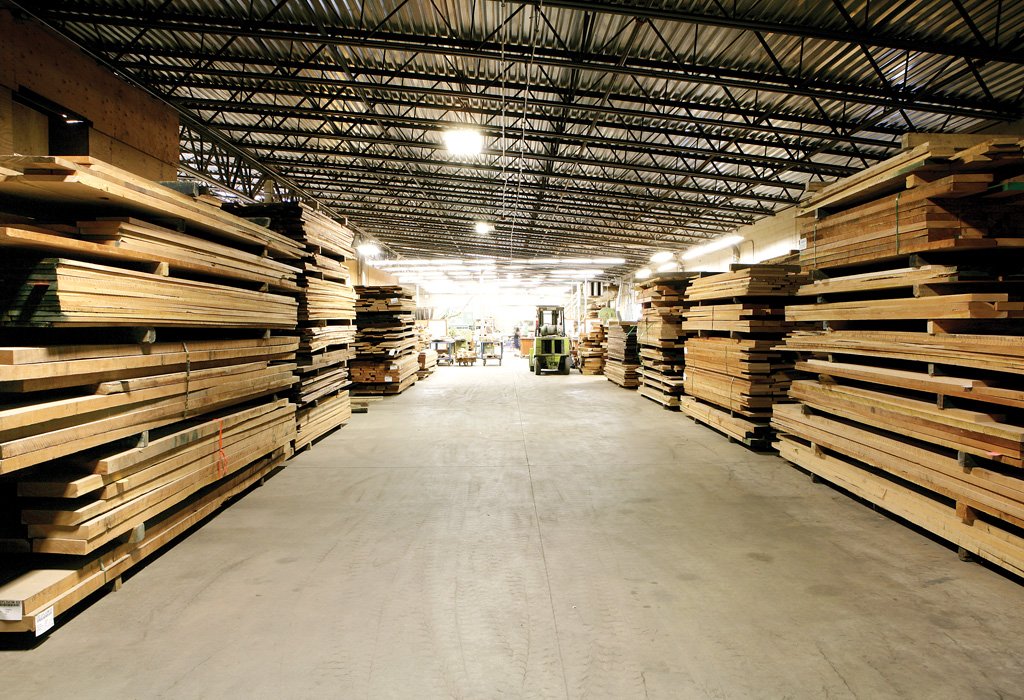
So when I visited Thos. Moser recently to make a chair, my first task was to choose the boards from which its parts would be cut. Woodworker Ken Charity, who’s been working at Moser for nearly 16 years, walked me to the cavernous wood storage space in Moser’s 71,000-square-foot woodworking shop.

As Charity gave me pointers, I looked through the wood piles in search of striking grains in boards free of imperfections like knots or discolorations.
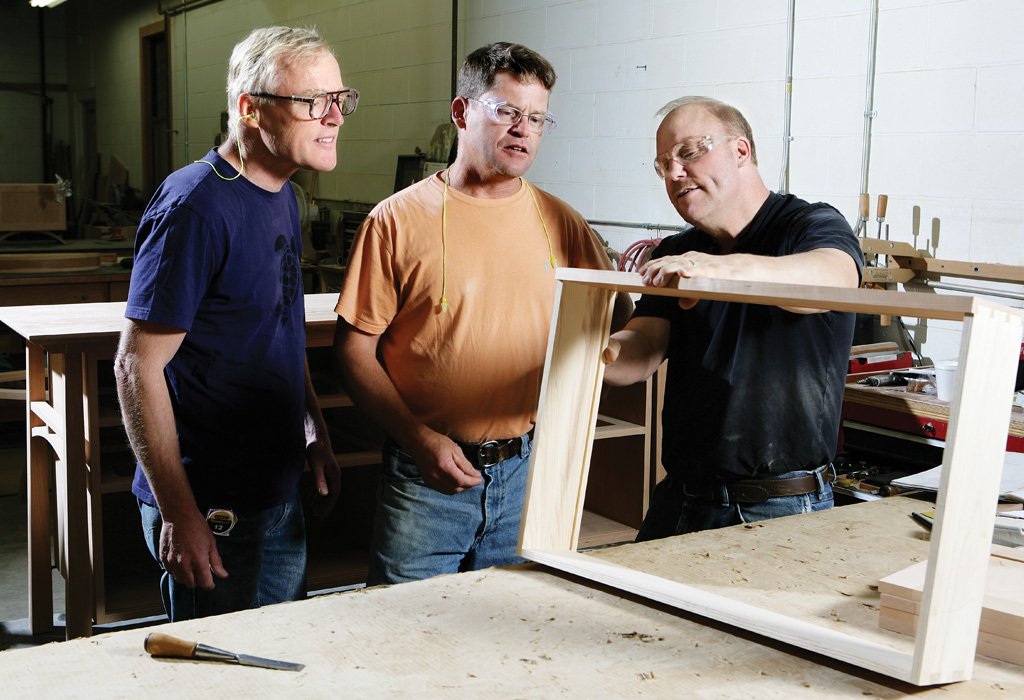
Thos. Moser had invited me to participate in its “customer in residence” program, one of the most unusual loyalty programs in the world of luxury. At least seven times a year, five devotees of Moser furniture travel to the shop to make a piece of furniture. For five days, each customer in residence works side by side with a Moser artisan, finishing on Friday morning. The program costs $3,500, and participants must also pay the retail price of the piece they’ve made, which can easily cost another $3,500.
Non-woodworkers might not understand the appeal: If you have five days to spare, why spend them wearing safety goggles and earplugs and coated with sawdust? But for fans of Moser’s handcrafted furniture, the program is like a ticket into Willie Wonka’s chocolate factory—rare and treasured.
Moser’s customer in residence program is also an immersion in the daily life of a high-end company whose workers practice a threatened art. Although it is rebounding now, Moser was hammered by the recession. Longer term, its founder and employees worry that today’s young people won’t share their elders’ interest in wooden furniture. Many of their clients fell in love with woodworking—as I did—while taking a shop class in school. But across the country, the number of schools offering shop classes has been declining for years, largely replaced by computer classes. How many of these kids will one day fall in love with a cherry grain or admire the beauty of a perfect joint? “There are people,” Thomas Moser admits, “who think that my work is already passé.”
The company is also going through a transition period—what Moser calls “the father-son thing.” At 78, Moser is still the company’s leader. A charismatic man, he is both open-minded and stubborn, sarcastic and serious, thoughtful and irascible. He refers to everyone who works there and does not actually make furniture as “parasites,” and he’s not really joking.
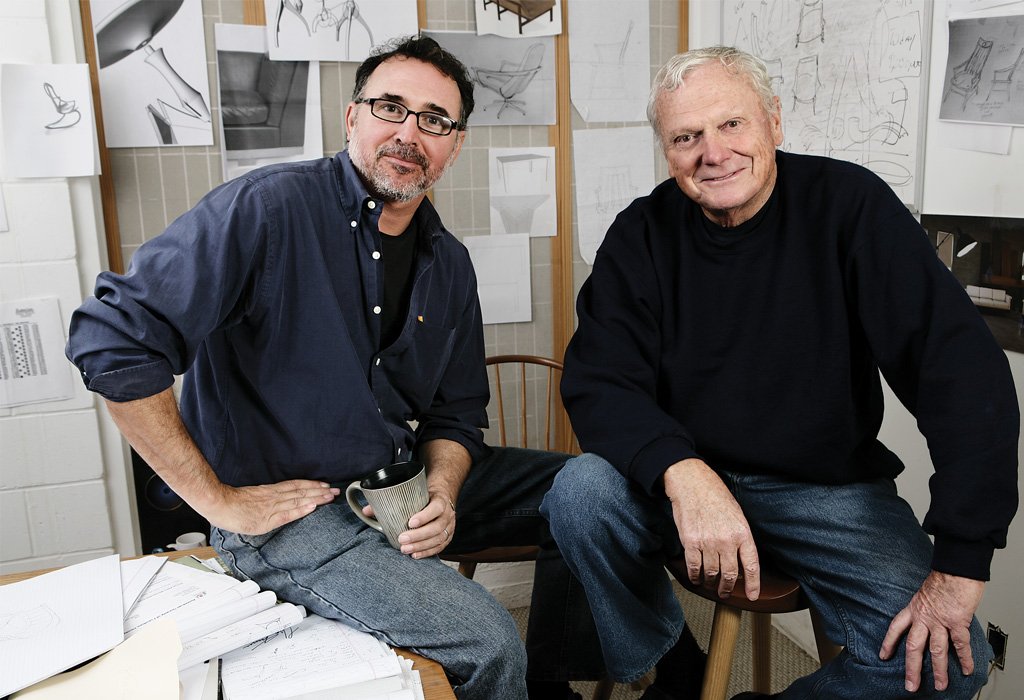
But Moser is technically retired. Of his four sons, three—David, Aaron and Andy—work at Thos. Moser; David, 49, is a designer; Aaron, 51, runs institutional sales; Andy, 54, heads the repair department. But their future roles are not wholly clear.
All this I learned in conversation with the Mosers and their employees. With the exception of meals, I spent my five days at Thos. Moser entirely on the shop floor, partnered mostly with a chairmaker named Paul Mathieu, under the same corporate supervision that my four fellow customers in residence had: none. No PR person checked in to make sure that I was being fed the company line—if there even is one.
The people of Thos. Moser are confident in their work. But they are also busy trying to keep their business—and their craft—alive.
In the world of wood furniture, Thos. Moser occupies a precarious niche. It is more expensive, with more attention to wood choice, joinery, sanding and finishing, than furniture sold at high-end stores such as Room & Board or Restoration Hardware. Though Moser furniture is made to order, most of it isn’t custom, yet its quality is comparable to that of an ultra-expensive custom piece. A Harpswell side chair, one of the company’s most popular pieces, starts at $1,175; a six-drawer American Bungalow horizontal dresser, $7,550. Compared to mass-produced furniture, this is expensive. In the realm of artisanal craftsmanship, it’s a relative bargain.
We don’t have enough of a budget in marketing to have a recognizable voice amid the clutter of 21st-century, staccato communication,” David Moser says.
Moser sells its furniture in showrooms in Boston, New York, Philadelphia, San Francisco, Greenwich and Freeport, Maine. The company also sells through a glossy catalogue and its website, though few customers purchase online. And it has a sales channel that markets to schools, libraries and corporations. Last year Thos. Moser had revenue in the low eight figures and a healthy profit—for the first time in several years. When the recession hit, says CEO Bill McGonagle, sales “fell off a cliff.”
Among people who know it, Thos. Moser is revered. It is to wood furniture what Patek Philippe is to watches: a maker of beautiful things to pass along to the next generation. But many people do not know the company. “We don’t have enough of a budget in marketing to have a recognizable voice amid the clutter of 21st-century, staccato communication,” David Moser told me.
Yet Thos. Moser’s is a compelling, uniquely American story. Its founder was born in Chicago in 1935. Thomas’ father, Joseph, was from Austria; his mother, Sabina, was German. Joseph was a stereotyper who helped create and align the lead plates used in printing the Chicago Tribune. In his 2002 memoir, Thos. Moser: Artistry in Wood, Moser described his father as “an artist in lead.”
Moser’s mother died of uterine cancer when Tom was 14; his father died of pancreatic cancer when Tom was 18. Dropping out of high school, Moser joined the Air Force. He spent most of his time in uniform on guard duty in Greenland and Alaska, “where there was nothing worth guarding and no one to guard against.” When he got out, he enrolled at the State University of New York at Geneseo and married his high school sweetheart, Mary Wilson. He also built a small house for himself and Mary even though “the only boxlike structure I had ever built was a stereo-speaker enclosure.” Moser went on to earn a PhD in speech communication from the University of Michigan, and eventually landed a tenure-track job at Bates College in Lewiston, Maine. But those were lean years: One summer in graduate school, he and Mary lived off corn that neighboring farmers let them pick.
Moser loved teaching, but grew frustrated with the Vietnam-era politicization of academia. Instead, Moser found peace of mind working with his hands; he liked the self-sufficiency of making something yourself. Plus, he could earn a little cash by buying battered antiques, then restoring and reselling them. Sometimes he would make reproductions of those antiques for sale or barter. In September 1971, when a friend asked to buy a pine table that Moser had just finished, he had an epiphany. “I suddenly saw,” he would recall, “that there was enough artistry in me to produce something for which people would pay money.”
Taking a leave of absence from his professorship—he would never return to it—Moser launched his business. He named it after himself because putting your name on furniture was a way to build trust with the customer. But in the fashion of the 18th-century artisans he admired, Moser abbreviated his signature.
Slowly, Moser built his company, finding customers through word of mouth and small ads in magazines such as Down East, a Maine publication, and The New Yorker. He started by building reproductions of Shaker pieces, then moved to his own designs. Often buying furniture so that he could take it apart to see how it was made, Moser became a self-taught historian of American woodworking.
If the style of Moser furniture was hard to define, its characteristics were deliberately visible; Moser wanted to showcase the wood and the craftsmanship that went into it. His furniture would not be painted or finished in any way that obscured the beauty of the wood. And he would leave the joints exposed, so that the woodworker could not cover up mistakes. Moser felt that there is beauty in seeing what holds an object together. Plus, visible joinery is an homage to the craftsman, and “a craftsman who is respected nearly always rises to the task.”
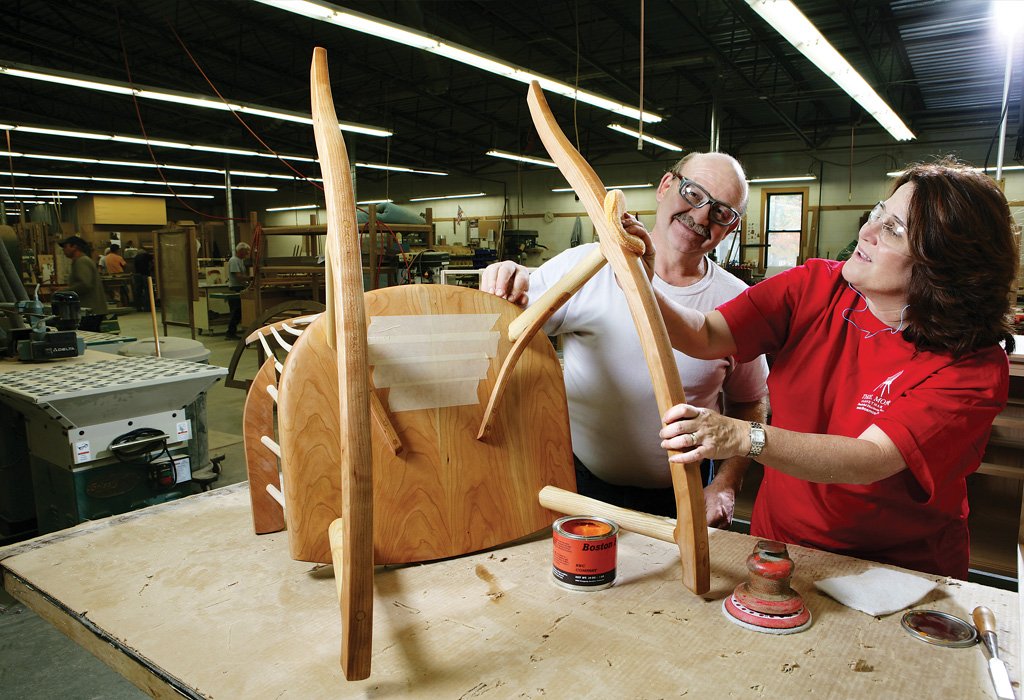
As a customer in residence, if hardly a craftsman, I hoped to make Moser’s “wing chair.” Made of cherry, the chair features a curved back and two side panels that twist outward, like wings. David Moser, who designs the more modern pieces in the Moser catalogue, designed the wing chair by reinterpreting an 18th-century Queen Anne chair. Paired with a matching ottoman, it looked graceful, elegant—and ambitious.
Ken Charity and I spent that first day selecting the wood, planing it, bandsawing it into approximations of the shapes, then using a jig—a wooden pattern—and table saw to craft those pieces into chair parts.
The next step was to cut mortises and tenons into the sides and legs, creating the joints that would later be glued together and pinned. Those tasks were done using a CNC, or computer numerical control, machine. The CNC converts a computer aided-design into a cutting pattern; once the wood is positioned and the right computer program called up, the machine cuts the mortises and tenons. It is not the romantic ideal of handmade furniture, but Thos. Moser makes no apologies for using these machines: All woodworking requires tools, and the CNC allows Moser to make joints far faster and more accurately—and at a lower cost— than one could create them using traditional methods like a drill press and table saw.
“I suddenly saw,” he would recall, “that there was enough artistry in me to produce something for which people would pay money.”
It would have taken weeks for me to learn how to use the CNC, so I watched as Charity operated it. That would not be the only time over the next days, working mostly with Paul Mathieu, that I had to just watch; if the customers in residence are to finish their furniture, there simply isn’t enough time for them to do everything on their own. Truth was, I appreciated the chance to watch Charity and Mathieu work. Like most of the customers in residence, I’m a white-collar professional who works in an office in a city. In the Moser workshop, I was out of my comfort zone, forced to stand and watch and learn as blue-collar craftsmen did work faster and better than I would ever be able to. That felt humbling to me, and healthy—the way that working with wood has always made me feel.
“How long does it take you to make one of these chairs?” I asked Mathieu, a soft-spoken man who got into woodworking partly to avoid the stressful career path taken by his father, a corrections officer.
Mathieu looked slightly uncomfortable. It turned out that the chair that would take me four days and a lot of help to make, he could make in a few hours. The obvious corollary is that Mathieu would have been far more productive if he weren’t working with me. Despite the high price of the customer in residence week, the company doesn’t really make money off it, Bill McGonagle says. But it does give passionate customers the opportunity to come to Moser’s shop, and the company does hope that the experience will build loyalty and inspire those customers to buy more pieces down the road. “Any of the companies I’ve worked with in the past would give their left arm to have their customers working side by side with their employees,” McGonagle says.
Over the course of the second and third days, my chair started to look less like a pile of wood and more like, well, a chair. I spent much of that time sanding the pieces to a flawless finish. Using an orbital sander, I went over the chair parts again and again and again, using progressively finer sandpaper, until Mathieu deemed them sufficiently smooth.
Twice a day, in mid-morning and mid-afternoon, the shop workers would put down their tools and take a break for a few minutes, grabbing a cup of coffee or a smoke outside. There was no bell to call them back, no flashing light, but no one dawdled returning to work. And I noticed something else: There was no supervisor on the shop floor. These artisans work at their own pace.
After each piece was smoothed, its maker would take it to the finishing room, where an expert would spray it with linseed oil and, once it dried, buff it with very fine steel wool and sandpaper. From there, my piece would receive a thin coat of lacquer and its upholstery before being shipped—all with no formal quality check. “I guess the finishers would send it back if they saw something,” Mathieu told me. “That would be a little embarrassing.” When a piece of furniture is done, its maker signs it, which gives the artisan the pride of creation and reminds the customer that an artisan made the piece.
“Tom started this company with the intent of restoring this lost art of furniture making,” explains McGonagle, who joined Moser in mid-2011 after years at toothpaste maker Tom’s of Maine. “We’re committed to this art, and to having a culture where one person can work on one piece.”
That commitment costs more than an assembly-line process. But “the quality happens that way. If one chair is passed through four people, you don’t have the same ownership and pride as if one person built it.”
Moser furniture is guaranteed for the lifetime of its purchaser. If a leg breaks on a Moser chair 50 years after you buy it—and you’re still alive—the company will fix it on Thos. Moser’s dime.
Late Wednesday afternoon, Mathieu and I glued and clamped the chair pieces together, then secured the joints by inserting a maple pin in a hole drilled into the joint. Carrying the chair to the finishing room, we passed Thomas Moser bent over a workbench. “What sandpaper did you finish that with?” he called out.
“220 grit,” I answered.
Moser nodded and resumed his work.
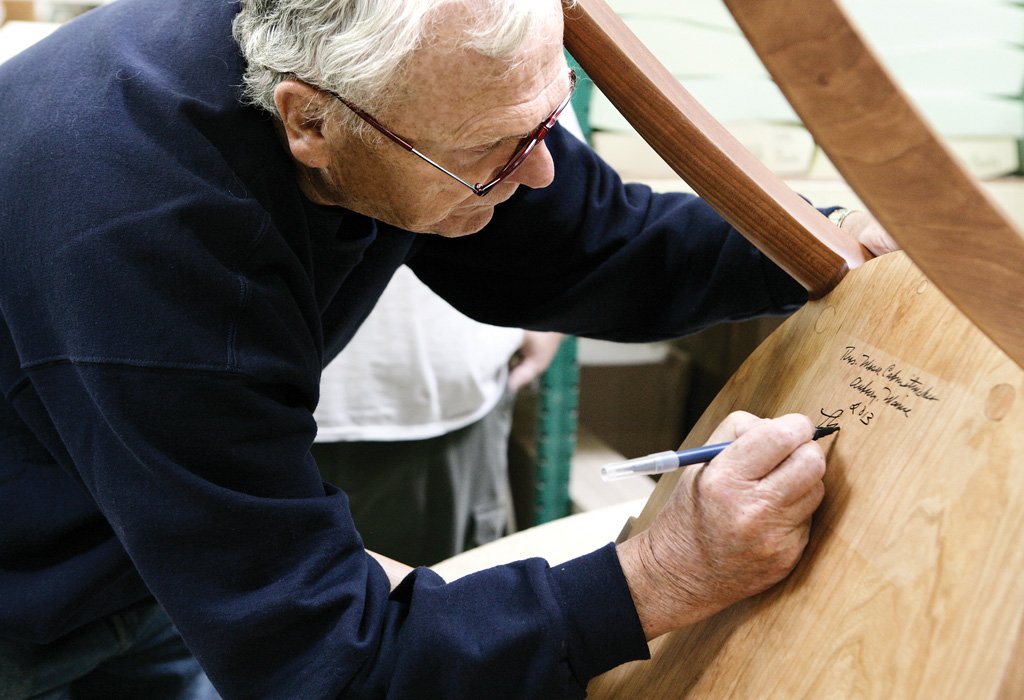
Late Friday morning, my fellow amateur woodworkers and I gathered in the front of the Moser workshop, where rows of finished pieces await shipping. In one corner sat the furniture we had made, including a king-sized sleigh bed; an elegant writing desk; an “Aria” chair, with its beautifully scalloped back; and my wing chair and ottoman. Work came to a halt as all the employees gathered for this “graduation.” Thomas Moser spoke, and each piece was signed by the woodworkers, the customers in residence and Moser himself.
The raw boards I had hopefully eyed a few days earlier had been transformed into a stunning piece of furniture, smooth to the touch, showing off a fiery grain pattern that was indeed evocative of dancing flames. I couldn’t take credit, really; Ken Charity and Paul Mathieu had done the hardest parts. But it didn’t matter. Yes, it had been deeply satisfying to refresh my woodworking skills. But the real value of the week was the opportunity to work with the masters of a profession whose continued existence cannot be presume d.
For more information on Thos. Moser, visit thosmoser.com. For more information on the firm’s customer in residence program, contact Steve Wyman, [email protected] or 800.708.9041.