
Most equestrian centers around the world serve specific disciplines. A show jumping arena, designed to accommodate an obstacle course for horse and rider, may not suit a dressage competition, in which horse and rider demonstrate training, skill and rhythm, and neither of these could ever share space with a polo tournament, which requires a 10-acre grass field. But in a remote North Carolina location, an entrepreneur named Mark Bellissimo is building something different—and unique. To get there from Charlotte, home of the nearest major airport, you have to take U.S. Route 74 out of town and into the foothills of the Blue Ridge Mountains. In Polk County, the greenery begins to undulate and the mountains rise in the distance—and then a massive compound off the highway interrupts the dreamlike scenery.
Three years ago there were hills here and a small mountain. Bellissimo is changing that. He’s rushing to finish an equestrian complex that features 12 competition rings, trails and bridle paths, shops and restaurants, more than 1,100 horse stalls and a log cabin village. Tryon International Equestrian Center, a name Bellissimo gave the project in reference to a horse club in the area in the 1920s, will also offer three hotels, private homes and a championship golf course. He doesn’t have much time to finish. In September 2018, an estimated 500,000 people will converge upon Tryon over the course of two weeks for the International Equestrian Federation (FEI) World Equestrian Games, also known as the WEG, the horse sports’ equivalent of the Olympics.


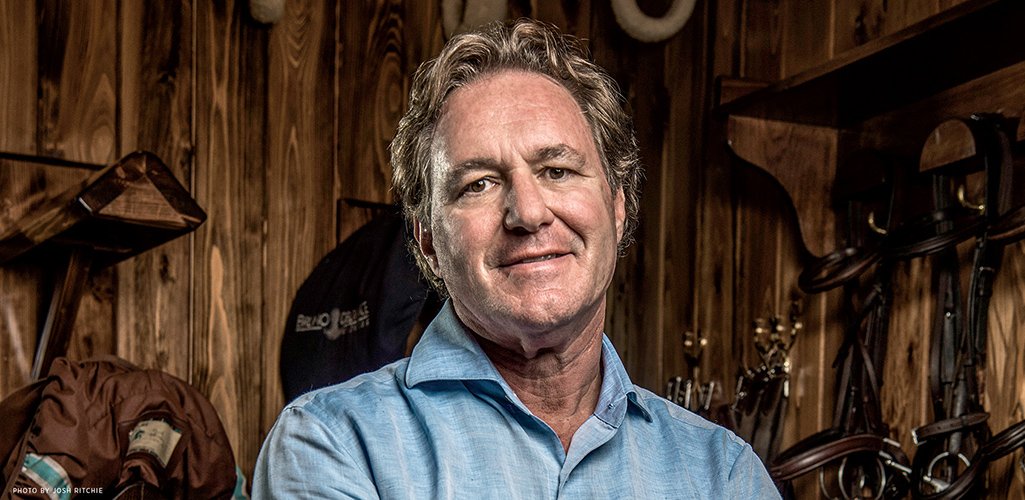
“The difference in equestrianism versus golf or tennis or football is that there’s only one permutation of those sports,” Bellissimo tells me. Dressed in white jeans and a rumpled blue button-down shirt—a simple uniform from which he seldom deviates—he sits down on a late-winter afternoon for a Greek salad with grilled chicken in Roger’s Diner, a ’50s-themed jukebox joint at Tryon. He speaks in a soft-voiced rat-a-tat-tat that reveals a mind eager to share the fruits of exhaustive analysis. “There’s a big equestrian population,” he says, “but no one thinks of it in a centralized fashion. It’s the ultimate in fragmented industries.”
Bellissimo is fond of rattling off statistics to prove the popularity of horse sports: that 27 million people apparently ride a horse every year, for example, far more than the 23 million who play tennis, the 25 million golfers or the measly 8 million skiers. Or that according to Alexa rankings, a metric for measuring internet traffic, there are more websites worldwide devoted to equestrian sports than almost any other sport. (Golf beats horses by a dozen.)
Bellissimo’s numbers may not be definitive, but it’s true that equestrian sports are seeing signs of growth. Horse show entries nationally—a good gauge of elite participation—have climbed by 20 percent over the last two years, for example. Last year’s Kentucky Derby posted the second-highest attendance in its history, while the Breeders’ Cup last November had its largest audience ever. But equestrian sports encompass everything from eventing to polo to horse racing, and multiple governing bodies regulate these activities independently, resulting in a disparate group of sports. The result: It’s hard to grow equestrian activities as a whole. For example, Duncan Huyler, CEO of the U.S. Polo Association (USPA), says his sport is “outside of all equestrian disciplines” and as a result struggles from lack of exposure. Bellissimo plans to change that. “We’re creating a business and industry centered around passion for the horse.”
Tryon is not Bellissimo’s first rodeo. For the past decade, the cherub-faced 55-year-old has been working toward building up the equestrian industry in the pastoral village of Wellington, Fla., where he has transformed a sleepy, five-week horse show, the Winter Equestrian Festival, into a 12-week, $200 million economic engine by uniting most disciplines under one umbrella and increasing accessibility to the sports. Bellissimo has also developed an equine-centered industry that includes luxury real estate—the barns for some prized steeds, in their own gated communities, sell for up to $20 million—an equestrian academy and multiple show venues. He even created variants of some disciplines to generate a new audience—Gladiator Polo, for example. “Even if we didn’t have real estate to sell, we’ve built a nine-figure revenue model in a place where it didn’t exist,” he says.
Bellissimo had never really been interested in horses before arriving in Wellington with his family in 2004. “Mark is an opportunity guy. He may not have a plan, but he’s very good at recognizing opportunity,” says his wife of 29 years, Katherine Bellissimo, whom he has known since high school.
As a teenager in Natick, Mass., a middle-class suburb of Boston, Bellissimo, one of six children, played hockey. His skill caught the eye of Ted Harrison, the athletics director at Phillips Academy Andover, the tony Massachusetts prep school. With Harrison’s help, Bellissimo enrolled at Andover. Though Bellissimo’s father owned a small food-service business, Belco, that evolved from running food trucks to providing corporate catering and cafeteria services—and would do well enough to move to the affluent town of Weston—Bellissimo was always aware of the financial expectations that an Andover education created. “That was a victory for my father, making sure he had provided the best education. His big line was, ‘Put a brain in your head, and no one can ever take that away from you,’” Bellissimo says.

He went on to major in political science with a concentration in economics at Middlebury College in Vermont. During a 1983 summer internship at the Overseas Private Investment Corporation in Washington, D.C., Bellissimo stumbled across his first entrepreneurial opportunity, a meeting with a Japanese manufacturer of inexpensive back-up alarms for trucks at a time when the devices were beginning to be mandated in U.S. cities. So Bellissimo convinced the company to make him its U.S. distributor, generating hundreds of thousands of dollars in revenue. “In relative scale it was small, but it was an amazing learning experience,” he recalls. “It allowed me to buy early computers and learn about technology and programming.”
After graduating in 1985, Bellissimo moved to New York to work at Credit Suisse in its entry-level training program, but his time there was cut short when the family business fell into financial difficulty. He and his brother Bill, then an assistant treasurer at Chase Manhattan Bank, moved back to the Boston area to restructure the company as it filed for Chapter 11. During that time, he also received his master’s at Harvard Business School, got married and went to work at L.E.K. Consulting, a corporate-turnaround firm. That experience led to an executive role in 1992 as VP of operations at Vitas Healthcare, a Miami-based provider of hospice services, where among other things he developed the company’s technical infrastructure. The hands-on experience allowed him to build and license technology that ultimately proved lucrative. “That was my first seven-figure payday,” he says.
Bellissimo used that knowledge to form a medical technology company called CareTools, which he later sold. Other real estate and private equity investments following the dot-com crash led to his purchase of Brandwise, a defunct comparison-shopping service that he rebuilt as a CRM and sales-force automation business. When that company merged with a Colorado–based firm in 2004, resulting in another payday, Bellissimo decided to take a break. “I wanted time to think about what I should do next,” he says.
In the late ’90s, Bellissimo’s then teenage daughters, Paige and Nicole, took up horseback riding near their summer home on Lake Winnipesaukee in New Hampshire. “My wife took our daughters to a local barn that had a camp, and they loved it,” Bellissimo recalls. “Katherine then started taking lessons with them, and all hell broke loose.” One consequence: winter trips to Wellington’s equestrian festival.
Wellington, a 30-minute drive west of Palm Beach, has long been centered around horses, attracting ultra high net worth seasonal visitors and residents such as Bill Gates, Laurene Powell Jobs and Athina Onassis. It’s not uncommon to see riders atop their horses on the side of the road, where a network of bridle paths connects neighborhoods to the Palm Beach International Equestrian Center. The venue anchors the community, with the most expensive real estate being closest to it, and is the site of the Winter Equestrian Festival. By the time the family chose to leave the Northeast to shift gears, the girls were serious enough about the sport that Wellington made sense.
But as the family delved more into equestrianism, Bellissimo began to examine its flaws. “The rental rates for stalls were ridiculously expensive. If I’m going to pay that much I want to own the property,” he says. The shows, held on a grassy field with no spectator seating, were equally unappealing. “If it was raining you were ankle-deep in mud, and there were porta-potties everywhere. It was a terrible experience, and you spent a lot of money to do it.”

Nevertheless, the festival was by most measures successful. In 2005, for instance, it had brought a reported $57 million of economic activity into the area. Yet it remained restricted to wealthy equestrians and did little to engage the local community or attract sponsorship dollars. “Wellington was sort of like a British colony in the middle of Africa,” remembers Kimberly Van Kampen Boyer, a Michigan–based horse breeder and dressage rider who has been a fixture in Wellington for 17 years. “The same people came, competed against each other and left.”
Bellissimo himself is not an avid rider. Once in a blue moon, according to Katherine, he will go trail riding on his aptly named quarter horse, Easy. But what Bellissimo lacks in riding ability, he makes up with a deep curiosity about the sport and a passion for transforming it. “He gets the connection with the horse,” Katherine says.
In 2006, Bellissimo and several partners, including Van Kampen Boyer, purchased the showgrounds and 200 acres surrounding it for about $135 million. He then secured a deal to run the Winter Equestrian Festival, giving him control over the Wellington equestrian experience. “Once I bought the showgrounds and the raw land around it, it created hyper-growth of value here,” Bellissimo says, because he clearly intended to invest further. “Equestrianism was self-isolating because it appeared elite and unattainable,” he says. “We had to bring it to a broader audience.” Bellissimo built grandstand seating, lengthened the winter equestrian season and changed the way they organized the horse show. He made general admission free, and installed Jumbotrons around the arena to help spectators follow the competitions. His riders received bigger purses, hospitality venues provided food and drink, and street performers created a carnival atmosphere to engage visitors.
Today, the Winter Equestrian Festival draws as many as 200,000 visitors over 12 weeks. The land around the showgrounds sells at $1 million to $2 million per acre—Bellissimo now owns 500 acres—and properties that once would have cost $300,000 have sold for $12 million. The equestrian center has 12 competition rings, 2,500 stables and a 7,000-seat main arena, as well as a riding school and a separate facility for dressage. “Creating global dressage here turned the tide—it was starting to atrophy in the U.S.,” says Van Kampen Boyer. “It’s brought us back.”
“The rental rates for stalls were ridiculously expensive. If I’m going to pay that much, I want to own the property,”
Bellissimo recognized other opportunities to promote horse sports. In 2013, he acquired the Chronicle of the Horse, a weekly industry magazine, and last year he bought the International Polo Club in Wellington for $72 million. Bellissimo expects to improve that facility as well as work with the USPA to give the sport a wider reach. “We saw what Mark’s done with the horse show with jumpers and dressage, and selfishly we want to be part of what he does,” says USPA’s Duncan Huyler.
One of Bellissimo’s big ideas is Gladiator Polo, a variant of arena polo, in which teams of three players square off in a 300-by-150-foot enclosed ring instead of on a grass field. For Gladiator Polo, the teams wear color-coded uniforms and mount ponies wearing matching leg wraps, saddle covers and hoods over their faces. Instead of prizefighters, the horses resemble executioners. Much faster and more intense than traditional polo, it resembles hockey, but the horses are the skates. On a March evening in Wellington, the new game drew hundreds of people, including Sven Odia, an avid polo player and co-CEO of the Germany–based real estate brokerage Engel & Völkers. “This is amazing—this is the place to be,” he remarked as he watched excitedly with his son from one of the VIP grandstand tables that flank the playing field.

Bellissimo is translating that enthusiasm into dollars. “If we create an extreme version showing the speed and toughness of the horse,” he says, “I can chase brands like Monster Energy [an energy drink] that wouldn’t typically participate and are looking for programming.” He secured his first $500,000 in sponsorship for Gladiator Polo in just 10 days, letting him award $250,000 in prize money over seven weeks, an unheard-of purse for polo. Bellissimo also landed a broadcast deal with NBC Sports. And he’s already planning a world tour of the sport, with people like Odia lining up to sponsor.
For all the benefits this overhaul of Wellington’s equestrian scene has provided, Mark Bellissimo’s Wellington experiment has not gone unchallenged. Prosperity has brought with it beastly traffic jams and noise pollution. Boston billionaire Jeremy Jacobs, who owns a 200-acre compound near the showgrounds, has fought this expansion of the center in a decadelong series of lawsuits and complaints to the village council that have prevented Bellissimo from building hotels and condos—imperative for growth in a landlocked community with finite real estate and only one hotel, a Hampton Inn. “He was going to build a clubhouse. He wanted valet parking for horses,” complained Lou Jacobs, Jeremy’s son and frequent spokesperson, of Bellissimo in 2013 to Boston magazine. “From my view at the outset, it was all about development.” Stymied by the legal blockades instituted by Jacobs and the village council, Bellissimo set his sights on North Carolina. “It was just so difficult to do anything in Wellington,” says Katherine.
Bellissimo had first visited Mill Spring, Tryon’s location, with his friend Roger Smith, an Atlanta investment banker with J. P. Morgan who had resettled on a farm nearby. Smith wanted to help the local community by developing horse sports in the area, which had been devastated by the closing of textile mills during the Great Recession. “I tried to do it without Mark’s input and wasn’t successful,” he admits.
This corner of North Carolina depends on tourism. Lake Lure, a tranquil community of summer homes on the water, has attracted visitors since the 1920s. Drawn by the scenery, Hollywood occasionally visited—movies such as Firestarter and Dirty Dancing were filmed here. The area is also home to a cluster of small wineries as well as gun clubs, and it’s a weekend escape for residents of nearby metro areas such as Charlotte, N.C., and Greenville, S.C. It also had some tourism infrastructure: Bellissimo purchased a failed residential development called White Oak Plantation, which came with an electric grid, sewage, water and even a golf course. The combination of inexpensive land, existing residential framework, natural beauty and proximity to international airports made this the ideal place for Bellissimo’s equestrian resort and helped him win the World Equestrian Games bid.
Bellissimo had not counted on snagging the WEG, an event that had already been awarded to the city of Bromont in Quebec. But when financing fell through for the Canadians last July, he made a last-minute bid with the endorsement of the U.S. Equestrian Federation—the umbrella organization that governs most horse sports nationally—and won. The coup, however, raised eyebrows. “People questioned if we could do that” because of the newness of Tryon, Bellissimo admits. The main showgrounds were built at warp speed and at a cost of more than $150 million. “If you try to do this very slowly, it wouldn’t work. But we did it practically overnight, so it is intriguing for a lot of people.” Bellissimo expects to invest $450 million overall.
If there’s a downside to securing a sports event that will inject $400 million into the local economy, it’s that it’s just 16 months away. The handful of log cabins at Tryon won’t be enough to handle the deluge of visitors, and local hotel rooms—especially those geared to an affluent clientele—are scant. While plans for a 180-room luxury hotel and spa managed by Salamander Hotels & Resorts are underway, owner Sheila Johnson has some pause. “We are concerned about the deadline,” she says. “But Mark will get it done. He’s a brilliant businessman, and he has his own world of urgency.”

In a way, the WEG, which brings eight horse-riding disciplines into one main event, represents what Bellissimo hopes to accomplish in Tryon. But because of the distances required by some sports, such as combined driving or endurance riding, host cities often have venues that are far apart. At the last WEG, held in Normandy, France, in 2014, some competitions were as far as a 45 minutes’ drive from each other, making participation and viewing difficult. At Tryon’s 1,400 acres, nothing is more than 15 minutes away from anything else. Though Tryon remains a bit of a mystery to most international competitors, “folks expect something pretty significant from Mark thanks to Wellington,” says Sharon Decker, the chief operating officer at Tryon.
Bellissimo isn’t worried about Tryon’s readiness. “We’re building tools that allow us to do it fast,” he says, referring to a modular construction business he acquired for $3 million. With special-ordered automated equipment, Bellissimo is able to churn out high-quality modular units in record time. Those log cabins at Tryon—some with two stories and luxurious cathedral ceilings—can be assembled and erected in just days, and he intends to apply the same principles to construction of the resort. “It’s easy to go out and start throwing crazy money, but I’ve been able to find really great assets and build inexpensively,” Bellissimo says.
Following lunch at Roger’s, Bellissimo drives his Range Rover to the top of a hill where he first stood in 2013. It overlooks the main arena of Tryon, where three years ago he directed work crews to remove 2 to 3 million tons of earth. He points down and tells me, “This used to be a mountain.”
Contact: Mark Bellissimo, [email protected], pbiec.coth.com, tryon.coth.com.