

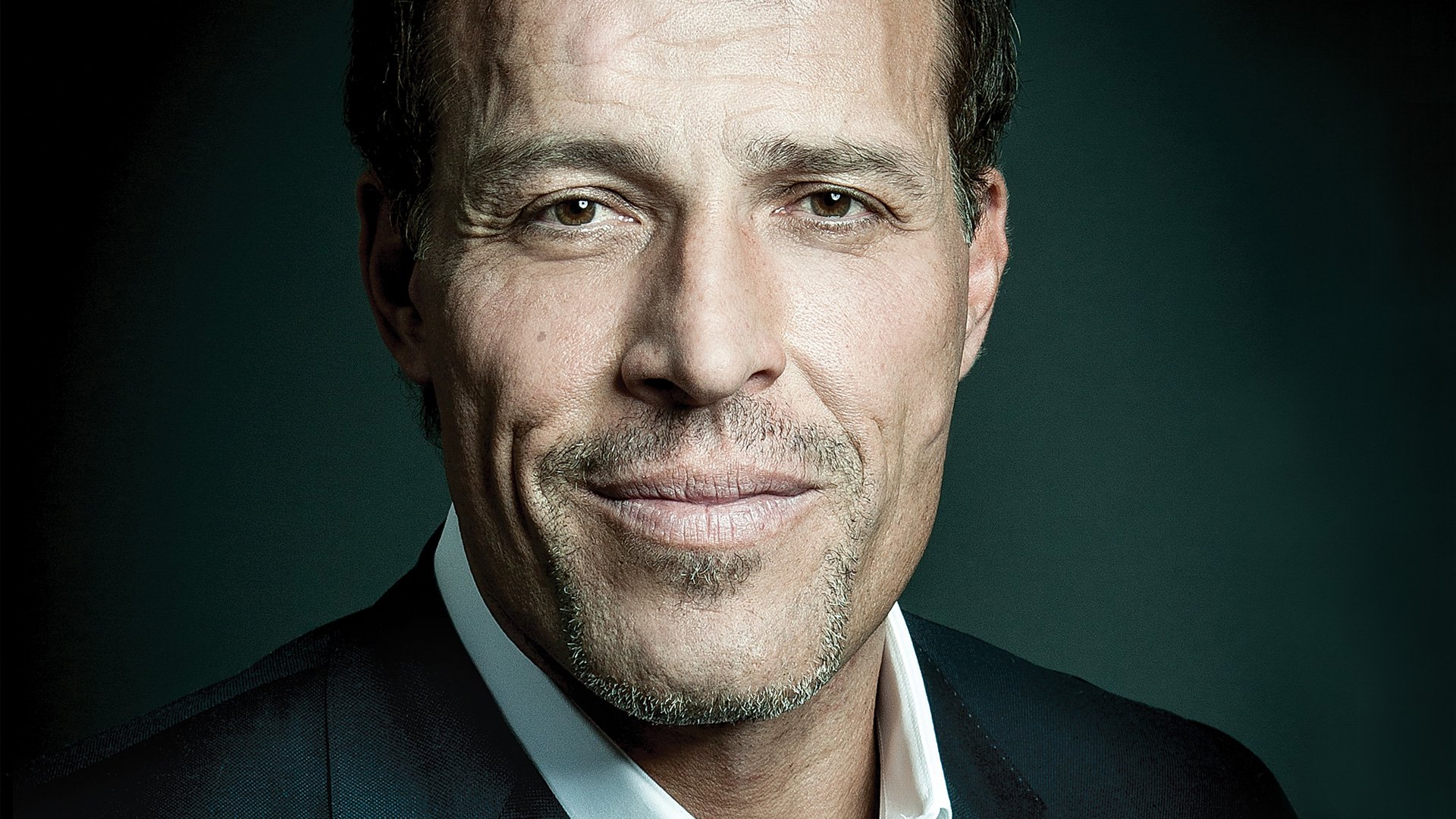
California-born Tony Robbins may have started his only-in-America career in “personal power” infomercials, but over the past three decades, he has built a business empire that includes 20 companies with sales of more than $6 billion annually. Robbins holds life strategy seminars for 10,000 people at a time and individually coaches pro athletes, entertainers, CEOs and presidents of nations. Now, with his first solo book in almost 20 years, Money: Master the Game: 7 Simple Steps to Financial Freedom, Robbins is expanding his focus into personal finance. And Money has friends in high places: Endorsers run from J.P. Morgan Asset Management’s Mary Callahan Erdoes and financier T. Boone Pickens to Oprah, Usher and Hugh Jackman to former president Bill Clinton. When it comes to money, does Tony Robbins speak to you?
Q: Your previous books have focused on individual motivation. Why write about money?
I’ve never been into “motivation.” A lot of people think that’s what I do or call it that for lack of a better term, but I’m really a life and business strategist. Motivation is nice, but if you’re all pumped up and start looking east for a sunset, I don’t care how excited you are, it isn’t going to work.

So how does a life and business strategist come to write about personal finance?
In 2008, when I saw so many people losing everything, it just made me crazy. Then in 2010 I saw the documentary Inside Job. [Director Charles Ferguson] did such a brilliant job of showing who destroyed the system and not only that we bailed them out but that we put them in charge of the recovery. The movie got people either outraged or depressed; I was outraged. I thought, What can I do?
Did you have much experience in high finance?
Few people know it, but I coach Paul Tudor Jones [of hedge fund Tudor Investment Corporation]. Every day he emails me with things he’s monitoring. I’ve worked with him 21 years now and he’s made money every single one of them—through the tech crash, 9/11, the subprime crisis of 2008. Because of that, I have unique access.
So you sought out financial experts?
I thought, I’m going to interview 50 of the most brilliant minds in the financial business: self-made billionaires, top hedge fund guys, Nobel laureates. The challenge was to take a complex subject and make it simple enough that anyone could apply it, while someone who is sophisticated could go really deep.
If people didn’t change their financial habits after 2008, do you really think they will now?
We’ve had five and a half years now of one of the great bull markets in history and everybody knows that things are being stretched—this can’t go on forever. Smart people are preparing themselves for how to take advantage when the season changes. But the average individual really doesn’t know what to do. The number one fear of baby boomers today is not death—that’s number two by a huge distance. Number one is running out of money while they’re still alive. And they should be worried, because one out of three of them only has $1,000 saved. We have an entire generation with which we did this experiment called the 401K. We made them into investment experts, which they are not, and now there’s going to be a significant retirement challenge. So people at this stage know they need to take control of their lives.
Did any of the 50 people whom you interviewed surprise you?
It was a big job to get people to share things they hadn’t shared before. My interviews were supposed to be about 45 minutes each; many of them ended up being about three hours. Jack Bogle [founder of Vanguard] told me I could stop by for 45 minutes, and four and a half hours later we were still talking. Carl Icahn, who is such a force of nature, agreed to meet. But when I showed up he said, “No video crew allowed.” I said, “But you agreed to this before.” And he said, “I don’t care.” OK, so, audio team, let’s sit down. And he says, “No audio team. Just bring a pencil. You’ve got 10 minutes.”
Three hours later he endorsed the book and has supported it in any way he possibly can.
So I’d say one of the most incredible parts of this journey is, once they understood what my real mission is, how generous people were.
What is your real mission?
I’m not getting a dime out of this book. I was fed by someone on Thanksgiving when I was 11 when there was no money and no food [in my household], and it changed my life to know that strangers cared. So at 17 I decided to feed two families, and doubled it the next year, and on until within 10 years I was feeding a million people. Now we feed two million people a year though my foundation, and my wife and I match the two million each year.
Last summer, while I was writing this book, Congress had recently cut food stamps by $8.7 billion. So I decided to donate all the profits, including the advance—I got a big advance, so I was able to feed 10 million people. Then I thought, Why don’t I feed as many people now as I’ve fed already in my lifetime? So on Nov. 15 I wrote a check for 50 million people to be fed. Feeding America, the number one hunger relief organization in the U.S., is working to get matching funds so 100 million meals can be served.
So the people I met with felt, this guy is sincere, he wants to help people, he isn’t looking to steal something from me. They opened up.
Give me an example.
Ray Dalio of Bridgewater. He’s made 21 percent compounded for 23 years before fees. I spent 15 hours in prep before I met with him so I could really make the most of his genius mind. I go in there and it turns out he’s been a fan of mine for 20 years. We go three hours. And after three hours I asked him what I asked all these people: If you could not pass on any of your money to your children, all you could pass on is a set of strategies or insights, what would it be? He said, “I’ve traded this all-weather portfolio over the years and that’s where I’ve put my money—money for my kids and money for my nonprofits—because I want something that can make money in all markets. I’ve backdated it to 1925 and it made money in every market.”
And how did this investment strategy achieve those results?
He started explaining that traditional asset allocation is a joke. When you’re at 60 stocks/40 bonds and you’re 50 years old and you think you have a balanced portfolio—well, why did everybody lose in 2008? You need to dig down. The reality is your money may be 60/40 but your risk is not 60/40. It’s not balanced. Stocks are three times more volatile than bonds. So in reality you’re 90/10. That’s why people lose their tails.
Dalio started to look at all the things that affect markets: Are interest rates up or down? Is the economy growing or shrinking? He thought that every type of investment asset does well in some environments and poorly in others, so he put together a matrix.

But how does that information help other investors?
I knew I could present that to readers, but even the wealthy person is likely to think, Well, that’s interesting, but that’s like giving me the formula for making chocolate cake but saying, “use some dairy products, chocolate, flour.” I need specifics, amounts.
So I said to Dalio, “Give me your secret sauce.” And he started giving me numbers. People can [buy the book] and they’ll be able to learn about his approach, word for word. I recommend you get an advisor to execute it for you, but if you’re comfortable, you can do it yourself.
What about for the investor who’s willing to take more risk?
If you can handle more volatility, you might want to listen to what David Swensen of Yale has to say—he gave us the portfolio he recommends. So I really got a range of perspectives, from Carl Icahn to Jack Bogle to Kyle Bass [of Hayman Capital Management], whose approach is “no fear.”
Do these financiers have anything in common?
First, every one of them identified that they don’t lose. Twenty-one years in a row for Paul Tudor Jones, 28 years for one of the funds—they don’t lose. The way to do that is that they all know they’re going to be wrong. That’s what surprised me. You look at the news, at the talking heads and they all know the answers. Really? All of these guys say, “I’m going to be wrong.” So on a certain level they have low expectations. But then they have a system to back themselves up.
What else united them?
Every single one was obsessed with asymmetrical risk/reward—taking the least amount of risk for the largest amount of upside. Paul Tudor, for example, had a challenging time back in 1993. The thing that turned it around for him was a five-to-one approach: He would risk one dollar only if he was certain he could make five dollars. If he’s right, the returns are astronomical. If he’s wrong, he could still make two dollars. Kyle Bass is another example—he never risks more than six cents to make one dollar. He can be wrong 15 times in a row and still make money.
So a lot of these guys aren’t afraid to take a big gamble?
Consider Richard Branson. If you think of a risk taker, you think of Richard. But Richard is a risk taker with his life; he’s not a risk taker with his investments. With any business deal, the number one question he asks is, “What’s the downside and how can we protect against it?” For example, Virgin Airways was a giant risk. There’s a lot of cost involved—planes are expensive. He negotiated a deal with Boeing that said, if there’s a problem, he owes nothing.
That’s how guys like that think. It’s not about being right, it’s about the right risk/reward.
If you could boil the book down to one message, what would it be?
Stop being the chess piece and become the chess player. You’ve got to become an insider, and it doesn’t take that much. The financial industry tries to make the financial world so complex and they use language to do it—they create a whole culture around their language and it sets them apart and gives them power. It’s the same with lawyers or doctors. With the financial world, for example, the average person thinks they’re paying 1 percent in fees. So why aren’t my accounts going up even though the market’s going up? Because there are 17 fees—but they aren’t all called fees. The average mutual fund costs 3.1 percent. In the book I teach the nine most marketed investment lies that even sophisticated people don’t always know.
So the takeaway is?
Ignorance isn’t bliss. Ignorance is poverty. Ignorance is pain.
Why would the already wealthy be interested in this book?
One, because it has the cumulative wisdom of the 50 smartest people in the world when it comes to finance. Two, because you can learn secrets of tax efficiency, which are critical. It is possible to play the game within the rules, to do it appropriately, ethically but also to make sure you get to enjoy your wealth. I show how to make sure you don’t eat up 10, 20, 50 percent of your returns.
And I show you how to structure your portfolio to beat volatility. It’s mind-boggling how many wealthy people put their money in mutual funds when the reality over 10 years is that 96 percent of them don’t touch the market. Four percent do, and they are constantly changing. There’s little doubt what to do. Warren Buffett says 90 percent of your money should be in index funds.
Beyond the obvious, why is it important to win the money game?
There probably isn’t a subject on earth other than politics, religion and sex that creates more emotion. Because money is whatever we project it to be. It’s a blank canvas. For some people money is evil. For others, it’s power. I look at money as a tool. Money can create or it can destroy. It can start a war or it can help a child. It’s not paramount, but if you use it right it can have an extraordinary impact.
But money isn’t always a key to happiness.
You have to make sure you master it rather than letting it master you. There are plenty of people with tons of money who still have a sense of scarcity. People think doubling their income will double their happiness. But studies show it raises it only about 9 percent. That’s the old research. The new research shows that it’s not what you have but what you do with what you have, how you spend it.
You can spend $10 a month differently and change your happiness level. If you invest in things, you’ll get very little happiness that’s sustainable. If you invest in experiences, the sustainability and depth of your happiness is biochemically proven to be usually two to threefold.
The second way to get the most out of your money is to use it to buy time. When you get rid of drudgery, you have time for the things that you feel passionate about, and that has a radical effect on your happiness.
The third effect money can have on happiness: Nothing, I repeat, nothing will change your level of happiness more than giving money to other people, those you love and those you don’t even know.
Are you speaking from experience?
One of the greatest money moments of my life was when I was just getting started. I had grown up in a very poor environment in California and we’d always wished we lived on the ocean. I called my mom and told her I had an opportunity to buy a condo on the beach. I told her I wasn’t sure I could do it, it was a stretch, and that she should meet me there to take a look. We walked through and she said, “I don’t care what it takes, you’ve got to do it.” And then I handed her the keys.
I can remember right now how that felt. I can feel all the emotions of being able to do that, and what it meant to her. It was one of the most magnificent moments of my life, all the awe and tears and joy. You’ll never get that feeling from spending money on yourself.