
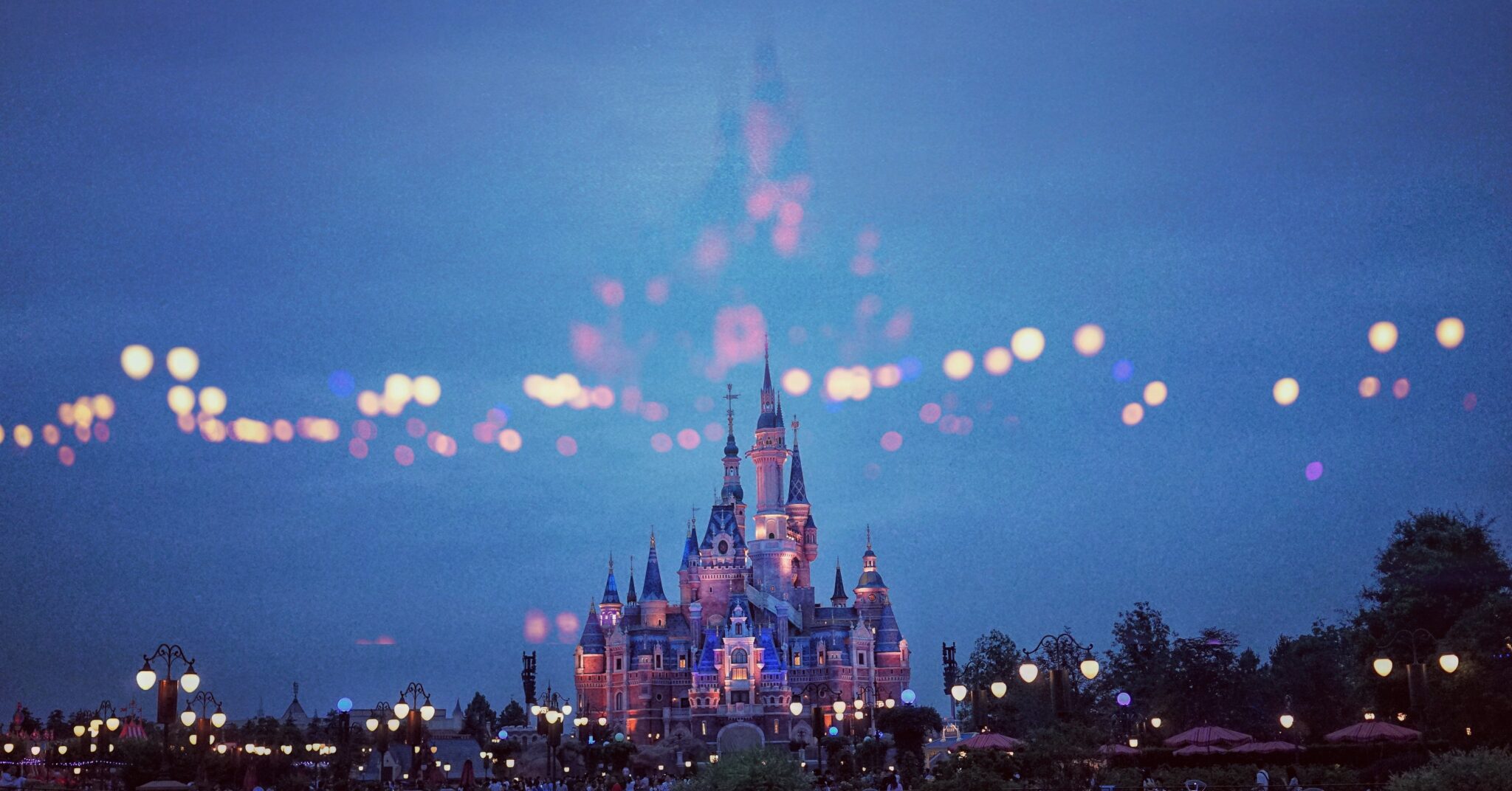
A few weeks ago, I was thinking about the history of Walt Disney World while riding in a mock train car with my sons on Mickey and Minnie’s Runaway Railway, one of several new rides at Disney in Orlando. The concept is simple and charming: Passengers riding on a train—Goofy is the engineer, which can’t be a good sign—are joined by Mickey and Minnie Mouse, embarking on a picnic in a spiffy red convertible. The four passenger cars become unhooked from the train engine, and their occupants—my sons and I, for example—go swirling off, dodging a twister, plunging down a waterfall, somehow finding ourselves whisking along on a treacherous factory conveyor belt. Fortunately, the passenger cars eventually reconnect with Goofy’s engine, Mickey and Minnie enjoy their picnic, and all is right with the world.
Wouldn’t that be nice? It’s entirely possible to surrender to the sensory depth of the ride, to lose yourself in the gorgeous animations and the iconic characters, and think about nothing at all. But when my sons, ages 9 and 7, insisted on riding Mickey and Minnie’s Runaway Railway once more, I used the time to consider how Disney connects past and present. Mickey Mouse, after all, debuted in 1928 in Steamboat Willie, a black-and-white short cartoon. Mickey played the part of a mischievous steamboat crew member who alternates between performing his duties and courting Minnie Mouse. Even then, Walt Disney (the man, not the company) was innovating: What really elevated Mickey to national prominence was Steamboat Willie’s groundbreaking use of sound synchronized to the story for comic effect—“a high order of cartoon ingenuity,” wrote Variety at the time. Sound was a movie rarity, and Mickey quickly became a star—Disney’s first.

Mickey and Minnie’s Runaway Railway pays homage to that history; the ride, which opened in March 2020, kicks off with visitors viewing a short cartoon, until the screen suddenly seems to split in two and you stride into its animated world. Since real estate at Disney World is largely a zero-sum game, Mickey and Minnie’s Runaway Railway replaced The Great Movie Ride, which used animatronic figures to reproduce 12 classic movie scenes. Some Disney fans grumbled about its closing—every Disney attraction has its own constituency of diehard fans, and The Great Movie Ride was the last surviving ride from the opening of Disney’s Hollywood Studios in 1989. But market pressures force change, and change means new technology: Mickey and Minnie’s Runaway Railroad is one of three new rides at Disney World that rely upon trackless technology, a system that uses computers and sensors rather than tracks to move the passenger cars, which creates the rather enjoyable sensation of gliding and bouncing like a ricocheting billiard ball. (The others are Remy’s Ratatouille Adventure, based on Pixar’s Ratattouille, and Star Wars: Rise of the Resistance.) Trackless technology also means that the cars take different routes along the “runaway” journey. If you ride it more than once, you’ll likely experience different adventures.
At the moment, unfortunately, you might say that Walt Disney World is on its own trackless adventure. First came the COVID-19 pandemic, which led to the closing of Walt Disney World and Disneyland in California, as well as Disney parks in Asia and Europe. Bob Chapek, named CEO in February 2020, promptly had to oversee the layoffs of some 30,000 Disney employees. Mickey and Minnie’s Runaway Railroad opened on March 4, 2020; Walt Disney World closed down on March 20. It would reopen relatively soon, in July—in California, Disneyland would stay closed for more than a year, not reopening until late April, 2021—with limited attendance and extensive safety precautions, including mandated mask-wearing. There would be no parades, no fireworks; children wouldn’t be able to get a hug from Mickey Mouse. And there was no guarantee that people would come. Could you really feel the magic of Disney while wearing a mask and waiting in lines separated by plexiglass barriers?
The answer was yes. During my visit in late January of this year, Disney was still mandating that people wear masks on the rides and while on indoor lines. No one seemed to care all that much about mask-wearing, and compliance was near-universal. (Walt Disney World lifted its mask mandate in mid-April.) The parks were packed with visitors, and Disney officials told me that attendance had been consistently strong. After two years of a pandemic and an Omicron peak in December, Americans had issued a collective sigh of relief that the worst of the virus was over. People needed some fun in their lives, and a lot of them were finding it at Disney. And then “Don’t Say Gay” happened.
That now-famous piece of legislation, known officially as the Parental Rights in Education Bill, was passed by the Florida legislature and signed by Florida governor Ron DeSantis in late March. Its proponents (some of whom now refer to it as the “anti-grooming” bill) say that the act prohibits the teaching of sexuality in grades 1-3, which is true. But they imply that this reasonable-sounding restriction is all the bill does, and that is not true: The bill, which seems deliberately written to be both broad and vague, will likely discourage Florida schoolteachers and counselors from talking about sex and gender in any pre-college grade. (A lesser-known part of the legislation prohibits any discussion of “sexual orientation or gender identity…in a manner that is not age-appropriate or developmentally appropriate for students in accordance with state standards.” That applies not just to K-3 students, but to all minor students.) The legislation also financially incentivizes any parent with a related grievance to sue their child’s school. It would be an entirely understandable response for teachers to decide that talking about issues of sexuality in any way simply isn’t worth the risk. LGBTQ people and their allies worry not only about the bill’s impact on LGBTQ youth in Florida, but also about the possibility that other states will pass copycat bills, some of which might be even more restrictive than Florida’s.
Though Disney CEO Bob Chiapek said nothing about the legislation at first, a confrontation with Governor DeSantis and the Republican-controlled state legislature felt, in retrospect, inevitable. Family is the heart of the Disney brand, and the company defines family expansively—it’s not just the right thing to do, it’s good business. Every year, for example, gay Disney fans organize what’s known as GayDays, a weeklong series of events in and around Orlando, one of which is a day at Walt Disney World. It’s estimated that between 150,000 and 200,000 gay visitors come to Walt Disney World on that day alone. The company doesn’t officially endorse GayDays, but social conservatives have long attacked Walt Disney World simply for tolerating it.
Disney is also known as a gay-friendly employer. It has, for example, offered health benefits for same sex partners since 1995, making the company an early adopter of that benefit. (Like GayDays, Disney’s health benefit prompted attacks from religious and social conservatives.) Disney matches employee donations to charity, but only if the recipient charity does not discriminate. As it has for over a decade, Disney earned a perfect score of 100 on the 2021 Corporate Equality Index, a widely referenced survey by the Human Rights Campaign Fund that rates companies on workplace policies related to LGBTQ issues. (One of the ironies of the current situation is that Disney’s gay employees are widely thought to be particularly good at promoting the parks’ family-friendly atmosphere; the idea of family has singular importance to people who struggle for inclusion.) There’s also abundant evidence that Disney’s creations have been enormously influenced by gay culture. (Hello, Cruella DeVille!). Twenty years ago, film and media scholar Sean Griffin wrote a fascinating book on the subject, Tinker Belles and Evil Queens: The Walt Disney Company from the Inside Out, detailing the dialectic between Walt Disney’s creations and gay culture since the time of Mickey Mouse. Now, Disney critics allege that the company is beholden to a small clique of “woke” employees. Disney’s history demonstrates that its engagement with the LGTBQ community is much deeper and more longstanding.
Keeping its offerings aligned with social change without offending people who disapprove of that social change is an ongoing challenge for Disney—and one to which it devotes considerable energy. In 2020 Disney announced that it was “reimagining” the popular Splash Mountain ride, which was based on the 1946 Disney film, Song of the South, itself generally recognized to be based on racist stereotypes of Southern Blacks. The new theme would be derived from the 2009 film The Princess and the Frog, which features Disney’s first Black princess. This year, in an attempt to modernize Minnie Mouse, Disney replaced her red dress with a blue tuxedo made from “responsibly sourced fabrics,” according to its designer, Stella McCartney. (The gender-blending outfit didn’t seem to make anyone happy.) Last year, Disney made some changes to the portrayal of indigenous people in its Jungle Cruise ride, eliminating a spear-carrying war party and shrunken head dealer, trader Sam.
Perhaps most upsetting to social conservatives, in 2021 Disney replaced its traditional pre-fireworks greeting—which began “Ladies and gentlemen, boys and girls….”—with one that began, “Good evening, dreamers of all ages!” The intention was to be inclusive of people who don’t identify as a lady, a gentleman, a boy or a girl. But the change inevitably inserted Disney into the middle of our current culture war over changing gender identities; it was like seeing swimmer Lia Thomas on a box of Wheaties.
For about two weeks after the passage of the Parental Rights in Education bill, Disney CEO Bob Chapek didn’t speak publicly against it. Instead, he cautioned that “corporate statements…are often weaponized by one side or the other to further divide and inflame.” Two days later, when that admonition failed to satisfy internal and external critics, Chapek did issue a public statement, explaining that the company had worked behind the scenes to fight the bill, but failed. “Our political approach, no matter how well-intentioned, didn’t get the job done,” he admitted. The Parental Rights in Education bill should never have been passed, Chapek said. He had asked Ron DeSantis for a meeting; Disney would “pause” its political contributions in Florida.
In the weeks following, Chapek would come under a torrent of criticism for his allegedly too little, too late response to the Parental Rights in Education bill. The criticism is probably unfair; it’s hard not to think that one of the purposes of the bill was to create political punching bags out of anyone who opposed it. And Chapek was between a rock and a hard place. He rightfully thought that speaking out in public could backfire and wasn’t likely to have any productive consequence. But if he didn’t speak, he risked alienating a large swath of Disney employees and supporters.
About one thing Chapek was certainly right. Almost instantly, his statement was weaponized to further divide and inflame.
In theory, Walt Disney World should have been happily enjoying an 18-month-long celebration of its 50th anniversary. Starting in October 2021, four months after it reopened from Covid, Disney World launched a massive, painstakingly planned program of new rides, fireworks displays, restaurants and menu items, merchandise and more to celebrate its opening in 1971. One new restaurant was Space 220, where diners appear to be seated in the belly of a starship, peering out into space. (Other spaceships and free-floating astronauts drift by on massive screens.) Perhaps the most anticipated event was the opening of Star Wars: Galactic Starcruiser, an “immersive” hotel where guests become part of the world of Star Wars. A new Guardians of the Galaxy roller coaster will open later this month.
On a more granular scale, Disney published a cookbook, Delicious Disney, featuring recipes from its various Disney World park and hotel restaurants, and a history, A Portrait of Walt Disney World—50 Years of the Most Magical Place on Earth. The cookbook is surprisingly ambitious (as is much of the food at Disney, if you know where to look), and the history, while not exactly a warts-and-all telling of Disney’s half-century, is often surprisingly insightful. A chapter on Americana at Disney is titled, “Nostalgia—An Idealized Yesteryear,” which is more candid than one might expect from an in-house publication.
Cultural historians and hardcore Disney devotees can also take a 50th anniversary tour. Starting at the Contemporary Resort—the first hotel to open at Disney World (and the one I stayed at during my first trip to Disney, in 1975)—participants travel by boat to the Magic Kingdom and see things that they simply couldn’t otherwise: the Cinderella Castle Suite, a cozy hideaway tucked within the heart of the iconic castle, only available to winners of Disney sweepstakes; a behind-the-scenes look at the oldie-but-goodie Haunted Mansion; even a visit to Disney’s mysterious “utilidor” system, the utility corridors underneath the Magic Kingdom that allow Disney “cast members” to travel to their posts without wandering through conflicting parts of the park. (The story goes that Walt Disney saw a cowboy walking through Tomorrowland on his way to Frontierland, and rightfully thought that the contrast undermined the fantasy Disney wanted visitors to experience.) The eight-hour tour is expensive—$6500 for a party of six—but for high net worth visitors and less-affluent but deeply passionate Disney fans, it’s an extraordinary experience, a glimpse behind the scenes of an American dream factory. Imagine the joy you could bring to a young child who crawls into bed at night in a hidden suite in Cinderella’s Castle and wakes up in the middle of the Magic Kingdom.
The story of Walt Disney World’s 50 years is a wonderfully American story—the tale of how a creative genius (Walt) and his more financially-minded brother Roy envisioned a fantasy world carved out of the brush and swamps of central Florida, and how generations of Disney leaders and employees transformed Disney World and the Walt Disney Company into hugely profitable global icons loved by millions of people all over the world. Generally considered one of the world’s best-run companies—it runs management training programs through its Disney Institute—Disney has maintained its brand as a family-friendly entertainment company during seemingly constant expansion, such as the acquisitions of George Lucas’ LucasFilm, Marvel Studios, National Geographic, Pixar and the ABC television network. Among others.
In recent years, Disney World has also developed a franchise of high-end offerings such as Golden Oak, a residential community within the park limits (as of this writing, the only available home is listed at $9.5 million); Club 33, a private club within the parks (visitors who don’t know won’t notice the unobtrusive entrances) with a membership fee reportedly hovering around $50,000; private guides that can cost up to $850 an hour; and the Galactic Starcruiser, whose rates begin at $4800 for a two-person, two-night stay. All this has created some tension among Disney World’s fan base, which typically can’t afford these luxury experiences and worries about being priced out of Disney World generally. It’s an understandable concern. Still, so far, Disney has managed to maintain its appeal to middle America even while working to offer rarer experiences for those who can afford them. It’s impossible to walk very far in a Disney World park without encountering groups—typically extended family members—clad in t-shirts they’ve created to commemorate their trip and help them locate each other amidst the crowds.
At the moment, though, this American success story is not exactly the narrative of Walt Disney World’s 50th anniversary celebration. The story has taken a darker turn.
Bob Chapek knew that public statements about political legislation can be used against those who make them. What he didn’t predict was the willingness of Florida governor Ron DeSantis to cast aside the standard rules of politics and business. Plenty of corporations have spoken out against laws they dislike; Disney wasn’t setting a precedent. In normal circumstances, what happens afterward is that company representatives meet with elected officials and their aides to try to forge a compromise. Businesses don’t want to make enemies of politicians, and politicians, especially at the state level, don’t want to damage companies that employ their constituents and generate revenue for their state. This is especially true when the corporation in question employs some 60,000 people in the state, is hugely popular, and whose brand has a halo effect that benefits the state generally—all of which are the case with Walt Disney World.
But Ron DeSantis, who is running for reelection this year and seems an almost-certain presidential candidate in 2024, tore up that playbook. Within days, DeSantis had accused Disney of attacking “parent’s rights,” promoting “transgenderism in kindergarten” and “trying to impose a woke ideology on our state.” DeSantis’ press secretary, Christina Pushaw, tweeted that “if you’re against the Anti-Grooming Bill, you are probably a groomer or at least don’t denounce the grooming of 4-8-year-old children.” (For those fortunate few who missed this nasty piece of sleaze, “grooming” refers to older people preparing children for abusive sexual relationships, with the implication that most groomers are gay or transgender.) This was a particularly insidious smear given that Disney World is filled with young children and costumed adults.
That these comments caricatured Disney’s position was hardly a new phenomenon in politics. But DeSantis quickly followed up with something that was different—retaliatory legislation that would eliminate Disney’s Reedy Creek Improvement District, a 50-year old agreement that essentially gave Disney self-governance over its roughly 27,000 acres in Florida. The bill was introduced and passed in an afternoon, and DeSantis signed it hours later. DeSantis didn’t hesitate to explain that the legislation was straight-up punishment for Disney for criticizing the “Don’t Say Gay” bill.
Also atypical was the fact that DeSantis launched this blitzkrieg even though killing off Reedy Creek and attacking Disney’s reputation will hurt Florida economically, for several reasons. One is that Disney World finances improvements on its land—the Reedy Creek Improvement District—by issuing bonds. If Reedy Creek is dissolved, the debt obligations of those bonds—reportedly about $1 billion—will be transferred to Florida taxpayers. Two, DeSantis’ attacks are damaging Disney’s brand and could well hurt attendance at Walt Disney World, which means less tourism revenue and fewer jobs for Floridians. And finally, using the legislature to punish a company for speaking against legislation—especially legislation seen as anti-gay— will inevitably scare other companies away from Florida. What major company is going to want to relocate headquarters or personnel to a state where the governor doesn’t hesitate to use his power for the purpose of political retaliation? What company that prioritizes ESG issues—as more and more investors and shareholders are demanding that they do—wants to move to a state whose governor punishes Walt Disney World for advocating for its LGTBQ employees? I’ve had more than one economic development head in other states tell me that they’re aggressively pitching Disney to move jobs out of Florida and to their state. That’s a possibility they would never even have considered a few weeks ago.
There are whispers that somehow Disney will convince the Florida legislature and DeSantis to walk back the anti-Disney legislation and preserve the Reedy Creek Improvement District. I’m not so sure. Love him or hate him, Ron DeSantis hasn’t hesitated to break the rules of conventional governance so far. As long as he thinks that doing so benefits him politically, why would he change?
If Americans thought that after the significant decline of the pandemic threat, we’d all get a chance to breathe deep and relax, to be kinder to each other and appreciate the joy of survival, this kind of culture war battle has made that detoxing more difficult. But at Walt Disney World, even with the current fight, it’s still possible to escape. On my last night there, my sons and I traveled to Disney Springs, a sort of Disney-sponsored, mixed-use shopping mall, to see a performance of Drawn to Life. The result of a new partnership between Disney and Cirque du Soleil, Drawn to Life tells the story of Julie, a young girl whose deceased father was an animator. While she and her mother are perusing a book of her own drawings, they discover a gift from her father—an unfinished animation. Tapping into her childhood memories of Disney characters, she strives to complete her father’s work, delving into a world of storytelling through animation—a world drawn to life.
Combining the athletics of Cirque du Soleil with the characters and spirit of Disney, Drawn to Life is astonishingly creative and deeply moving. My sons, who don’t easily sit for two hours for anything that doesn’t involve Minecraft, sat transfixed. Drawn to Life is also inclusive—it includes performers from 15 different countries—but in such an organic way that one might not even notice that people of every skin color—and, I imagine, sexuality—fill the stage. If all these young people on stage, and the even younger ones in the audience, represent the future, I can breathe a little easier.