
There are two ways you’ll encounter Port of Mokha coffee for the first time. One is as a freshly brewed cup at a premium roaster such as Blue Bottle Coffee. The other is in a small, square gift box crafted by the same designers behind the iPhone box. In both cases, you’ll be struck by a few things: The coffee is mild and doesn’t require the addition of milk or sugar. It has notes of cherries or raisins or some half-remembered fruit from your childhood. And its flavor will change subtly as it cools, like a red wine after it’s breathed for a while. It’s probably the best coffee you’ve ever tasted. But it is something of a miracle that you’re actually getting to taste Port of Mokha. Bringing it to the United States required a journey over dirt roads and oceans, through war zones and airspace, to get it from Yemen, where it is grown.
“When people think about Yemen, they think about what they hear on Fox News: death, desert, Al-Qaeda,” says Port of Mokha founder and CEO Mokhtar Alkhanshali. “When really, it’s a beautiful country. We live in a very divisive time. I think coffee is a way to bridge barriers.”

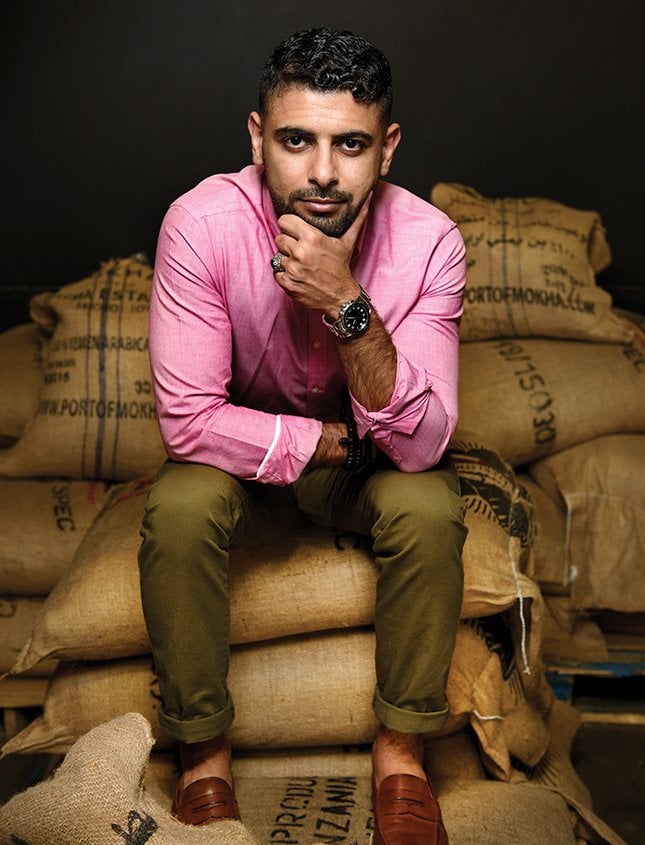
The son of Yemeni immigrants, Alkhanshali, 29, grew up in Brooklyn and San Francisco and made frequent trips to Yemen, where he still has a large extended family. He had intended to become an attorney. But while he was working at a nonprofit that offered free immigration legal work and volunteering with the ACLU in San Francisco, he found himself increasingly drawn to the coffee industry as a connection to his roots. He began traveling to Yemen, exploring the country’s coffee legacy.

Coffee has its origins in Ethiopia, where, according to national lore, it was discovered by a man named Kaldi who saw his goats behaving strangely after eating the berries of the coffee plant. Following Kaldi’s discovery, according to the National Coffee Association, the coffee plant was carried abroad, first to Arabia, and by the 15th century, it was cultivated in Yemen. The Middle Eastern desert nation proved to be an ideal location to grow coffee: The relative dryness of the climate stressed the plants, making the berries sweeter and giving them more complicated flavor profiles. “The mother of all coffees originated there,” is how Alkhanshali puts it.
Today, while only 30 coffee varietals are grown commercially around most of the world, and most coffee-growing nations have only one or two varietals under cultivation, Yemen boasts hundreds, maybe thousands of varietals; Alkhanshali says the exact number of Yemeni varietals in unknown. They include some of the most sought-after tastes: Hundreds of years ago, coffee drinkers began adding chocolate to coffee grown in Java and calling it “mocha” in imitation of the flavor of coffee exported from the Port of Mokha in Yemen.
“We live in a very divisive time. I think coffee is a way to bridge barriers.”
Bucking the expectations of his parents, Alkhanshali decided to try to import Yemeni coffee to the United States. He began making regular trips to Yemen in 2013. “Initially, I was doing it on the side as a hobby. Then one of my mentors said, ‘You know what, if you’re going to do it, you’re going to have to just do it.’”
By 2015, he had identified farmers who he believed could reliably grow coffee at a high enough quality for export. But Yemen was being torn apart by a civil war between the government and the Houthi rebels whom it discriminated against. Compounding this conflict, the U.S. was carrying out a protracted drone war against terrorist groups in the country. The ubiquitous violence made business dangerous and export difficult. Undeterred, Alkhanshali went to Yemen in the spring of 2015 to bring back berries for the Specialty Coffee Association’s expo in Seattle, where he hoped to meet an American coffee roaster he could partner with. “It’s like the coffee Olympics,” he says.
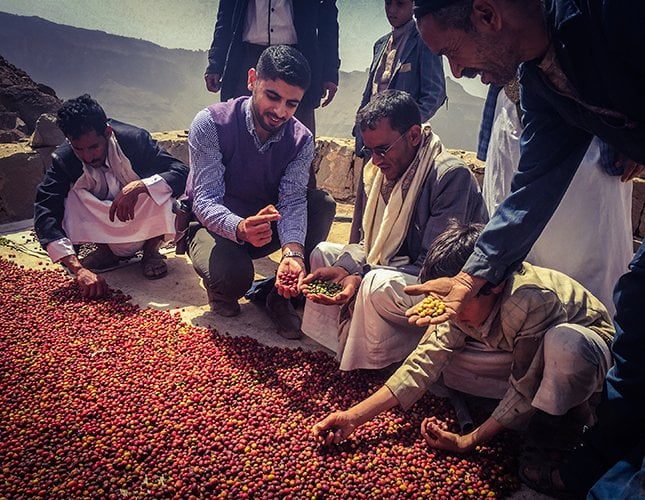
On March 27, the security situation in the capital, Sana’a, deteriorated rapidly. The Houthi rebels had seized the city, and Saudi Arabia launched airstrikes against them. Overnight, the entire country became a war zone, and all flights into and out of Sana’a were canceled. Alkhanshali found himself unable to return to the U.S.
“I woke up. I heard these explosions going around, and I went outside and saw what looked like laser beams,” Alkhanshali recalled in a subsequent podcast. “It was these anti-aircraft machine guns. The blast was so strong that some of the metal on the door was bent inwards. I was terrified. I just stayed in the corner and waited it out.”

The U.S. Embassy was unable to help him escape. So he found a friend who drove with him for seven hours through Houthi territory and frequent roadblocks to the Port of Mokha, where he chartered a 20-foot fishing boat with a 40-horsepower motor to cross the Red Sea to Djibouti, where he hoped the American Embassy could get him onto a flight.
“It wasn’t until probably a half hour into the boat ride that I realized, Wow, I’m in the middle of the Red Sea on a small boat, with no navigational equipment. I mean, what am I doing? There are pirates in this ocean,” he told NPR a few days later. After a five-hour journey, he made it to Djibouti and eventually onto a flight, carrying 30 kilos of coffee samples.
“When coffee from Yemen is good, it’s really good. I tried it, and it stopped me in my tracks.” —James Freeman

Alkhanshali’s story got to Seattle before he did, so when he arrived, the nation’s top coffee roasters were eager to try the beans—priced at an astonishing $260 per pound—and see if they lived up to the hype. They did. Specialty roaster Blue Bottle Coffee (in which Nestlé bought a majority stake in September) put in an initial order.
“It was the first single-origin coffee we sold,” says Blue Bottle founder James Freeman. “Mokhtar gave us first crack at some of these lots, some of which were really transcendent.”
Freeman had been looking for a reliable source of Yemeni coffee for years, but had been unable to access one prior to Alkhanshali’s entrance into the market. “When coffee from Yemen is good, it’s really good,” he says. “I tried it, and it stopped me in my tracks.”
Another specialty roaster, George Howell, founder of George Howell Coffee, said at the time, “There was nothing like it. You rarely get these more subtle nuances of spice and floral that are in Mokhtar’s coffees.”

And consumers began to hear about it. Within two years of hitting the United States, Alkhanshali’s coffee, now called Port of Mokha, received the highest score Coffee Review, a magazine that profiles coffees for aficionados, had ever given in 20 years of rating beans.
Because Yemeni coffee is so rare in the U.S., and Alkhanshali’s beans are so exceptionally good, Port of Mokha is the most expensive coffee on the market by far, retailing for $16 a cup. The farmers who grow the beans receive a 33 percent premium over what they would otherwise be making, an incentive for them to abandon growing illegal crops such as the stimulant khat and a reason for their communities to protect the Port of Mokha supply chain. That commitment is serious. Alkhanshali recalls eating lunch with a group of farmers when a loan shark, angry that he was losing business as the farmers’ livelihoods improved, threatened to kill him. “One of the farmers took out a grenade and said, ‘You mess with Mokhtar, you have a problem with us.’”
Port of Mokha recently instituted an obsessive quality-control regimen and provides tools, training and microloans to farmers to improve their ability to grow premium-quality beans. “In the last year, we’ve increased production volume 20 times,” Alkhanshali says. The upcoming January shipment should come in around 40 tons, up from just under half a ton for their first shipment two years ago.
The company is now backed by Peter Thiel’s Founders Fund and seed investor 500 Startups for an undisclosed amount. Founders Fund clearly loves the product; it purchased 200 Port of Mokha gift sets, which retail online for $158 each, for its upcoming shareholders meeting.
Alkhanshali describes the margins for his coffee as “healthy,” and the company is deliberately pursuing a common strategy in luxury businesses of pushing excellence and scarcity simultaneously. “We might raise the price because demand is high right now,” Alkhanshali says. Alkhanshali and Freeman liken the cost of a cup of Port of Mokha to buying a glass of wine. Wildly extravagant compared to what most people spend for their daily fix, but probably still affordable for many people celebrating a special occasion.
Port of Mokha is deliberately pursuing a common strategy in luxury businesses of pushing excellence and scarcity simultaneously.
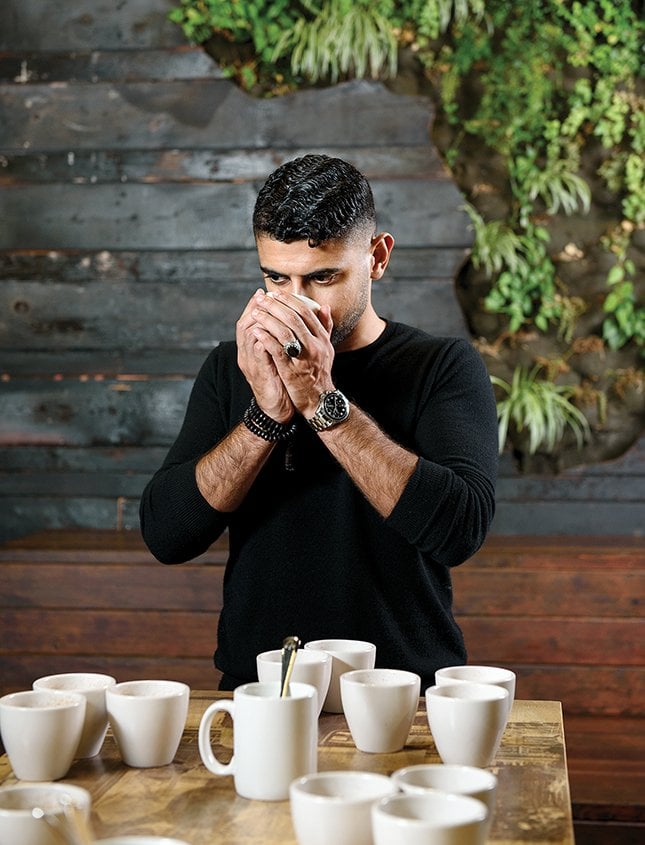
The direction of the coffee market suggests Alkhanshali is making a smart play. The U.S. coffee market is valued at around $48 billion, according to the Specialty Coffee Association of America. Specialty coffees account for 55 percent of that value despite making up only 31 percent of volume. And with global coffee consumption rising, both in key markets such as the U.S. and Europe and in developing nations such as Brazil, the total volume of specialty coffee consumed will likely continue growing as well.
Port of Mokha’s success is due to a pretty simple formula, says Alkhanshali: “putting together the right resources with the right minds and making something.” Blue Bottle’s Freeman argues there’s more to it. “I don’t know if I would call Mokhtar lucky,” he says. “Fortune favors the bold, definitely. He has been very bold.”
For information, contact: Ahmad Ibrahim, COO/CFO, [email protected], portofmokha.com