

This is the second volume of Adam Hanft’s column series, Annals of Attraction, which brings together things he likes under one sheltering-in-place roof. Read volume one here.
I want to make up for neglected thank-yous, having failed to extend my appreciation last time to Emily Cegielski, who edits Worth with careful wisdom; Juliet Scott-Croxford, our cheerfully overworked CEO; and my friend Jim McCann, who is the chairman of Worth, for indulging my easily distracted brain.
Which brings us, in a rare moment of linearity, to Freewrite.
Write in Peace
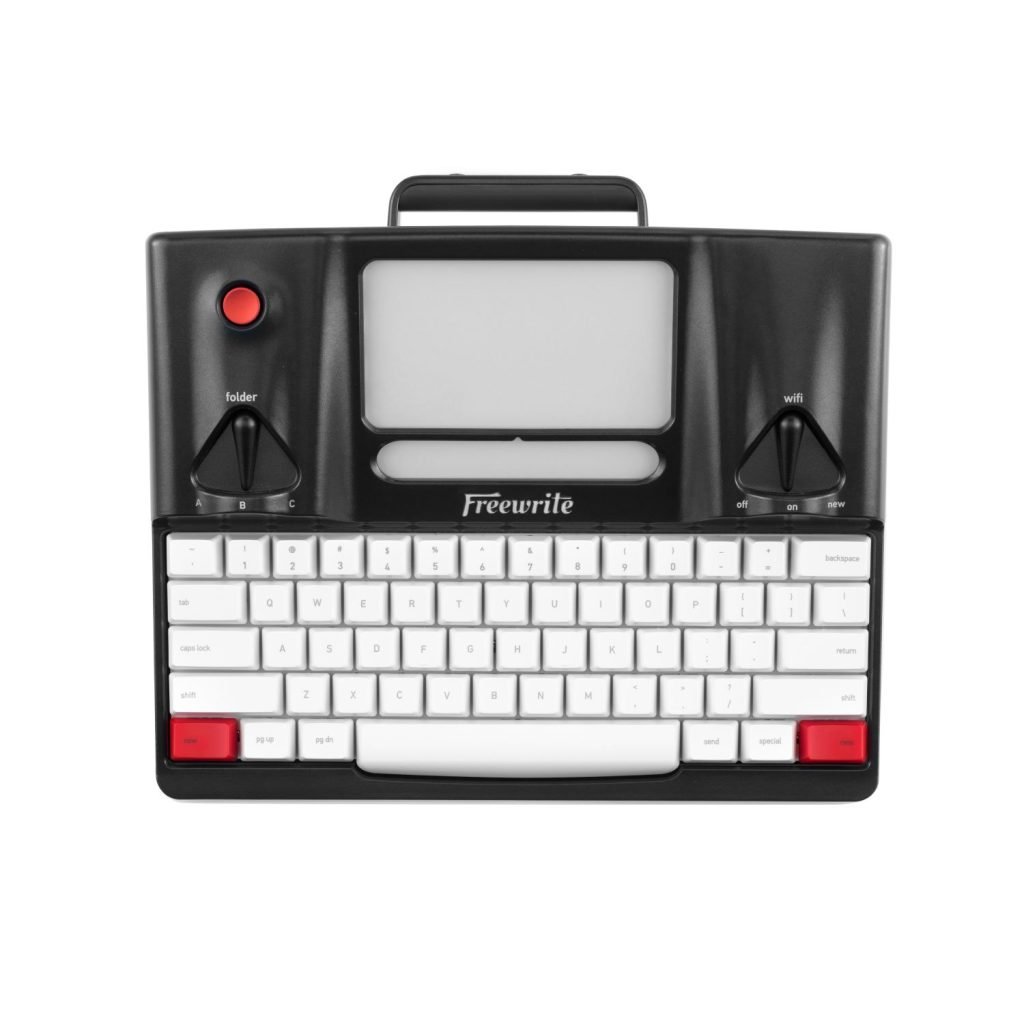
There are two ways that any writer, poet or even PowerPointer can wall themselves off from distraction. One is exerting more willpower than most of us possess, and the other is to plop down a discounted $549 for a Freewrite, an e-ink keyboard that, as the company says, is a “distraction-free writing instrument designed to help the modern writer get in a flow state and stay there. In a time of buzzing notifications, clickbait headlines and constant connectivity, the Freewrite provides a rare sanctuary for writing.”

You finish your draft, and then “edit in a separate session on a computer. By separating these processes like our writing teachers taught us, we see writing productivity skyrocket as much as 2x.”
In the pre-electronic age, isolation was relatively easy. Marcel Proust wrote in a cork-lined room, Victor Hugo allegedly gave his clothes to his servant so he could not wander.
While there is no scarcity of ironic commentary on life today, paying for the masochism of solitary confinement is something to write about…if you can pull yourself away from Fortnite.
Streaming Paradise

Jorge Borges wrote that he “…always imagined that Paradise will be a kind of a library.” The pandemic has shut off millions from that paradisiacal prospect, just when we are the most ravenous for what it brings. Thankfully, libraries have been forward-looking in using technology to flex their reach, and one such example is Kanopy, a free streaming service for anyone with a library card. (They also partner with universities.) They describe themselves as “the best video streaming service for quality, thoughtful entertainment.” (Best? I’m tickled that libraries are speaking like marketers.)
I won’t begin, can’t begin, to even summarize Kanopy’s impressive inventory, but I will point out that all those who are wont to describe situations where there is no agreement on what transpired—perhaps a Zoom conference—as a Rashomon-like event can finally match the metaphor to the movie.
A Laughing Matter
I have one of those liminal memories—crisp but shadowy—of my grandfather playing the “Laughing Record” on what he and millions of others called a Victrola. It was just that, a soundtrack of nothing but varying degrees of chucking and chortling, often working itself up into a sustained frenzy. It’s on my mind now because it represents an immigrant’s astonishment at the bounty and freedom of a country where people are willing to pay good money simply for the privilege of hearing people laugh. But hey, isn’t that a wonderfully inane and healing manifestation of “the pursuit of happiness”?
Pursued by memory, I did some digging and it turns up there was more than one version of this existential commentary. The first was the “OKeh Laughing Record”–issued in 1922, it entered the National Registry in 2003. It was believed to have come from Germany, which either discounts or reinforces—depending on your perspective—the stereotype of Germans lacking a sense of humor.
In 1946, the bandleader and king of the novelty song Spike Jones released his version, “The Jones Laughing Record (Flight of the Bumblebee),” which Cary O’Dell, who has devoted a worrisome amount of time to this archeology, describes as commencing with “a rather slow, sad, even funereal performance, only to be quickly interrupted by a woman’s high-pitched, unrepentant, seemingly unforced and genuine laughter. She is quickly joined by a deep-voiced male—who, too, seems unable to contain himself. The mystery woman and man’s continuing, building chorus of giggles and guffaws eventually come to drown out, even usurp, the tony musical selection being played.”
“Spike Jones, I should say, inspired the rebranding of the writer and director Spike Jonze, who, cue up your laughing record, was born Adam Spiegel.
Listen Up
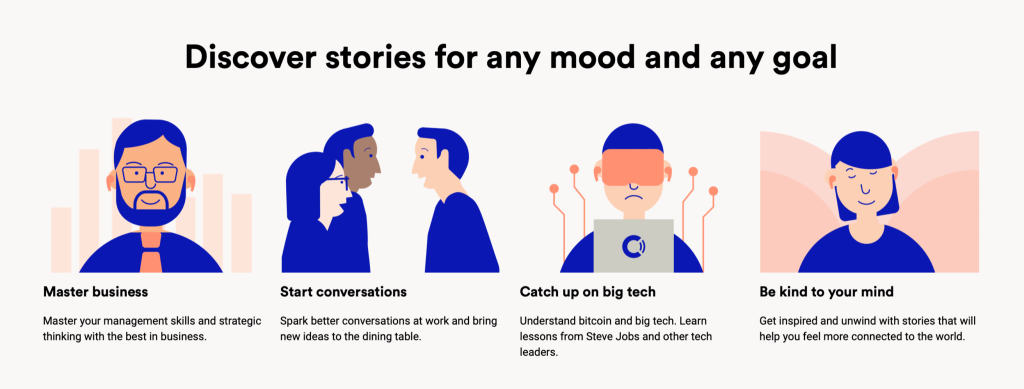
If you’re wondering why you need someone to read the news aloud to you, I give you the words of the wonderful writer Anne Fadiman, who said, “Reading aloud means no skipping, no skimming, no cutting to the chase.” Curio is a smartly curated subscription app (modestly priced) that ransacks the best of The Economist, Aeon (a particular favorite of mine), the Guardian, MIT Technology Review and other usual-suspect brands and turns them into elegantly narrated audio.
There’s a lot of debate about the merits of reading versus listening, but there’s no doubt that today, particularly, the slow-unfolding of a narrative can capture and hold attention in ways that amplify comprehension and gist-finding. I love Curio precisely because it is an attention-commander, and multi-tasking during an article feels like a slight to the efforts of the narrator, while reading is a temptation magnet.
The Light of Lost Carnivals

This is a reasonably collectible form of iridescent glass that was largely produced between 1908 and 1928. Originally designed to compete with Tiffany art glass, it failed to achieve that marketing goal—for obvious aesthetic reasons—and was pivoted, as we say now, to lower-cost, mass items. Because some of it was given away at carnivals as prizes, it took on that eponym, even though “the vast majority” was purchased for home use. Much of is it affordable; eBay has an entire department that has pieces from well over $10,000 to well under $100.
We’ve lost the carnival this year—the sugary smell saturating the molecules in the air, the creaky but defiantly sturdy rides, the fireworks and deep-fried carbs, the never-to-bed kids overwhelmed by the engineered spectacle—which is probably what draws me to these items, many of which survived the first American pandemic, as we shall, too.