
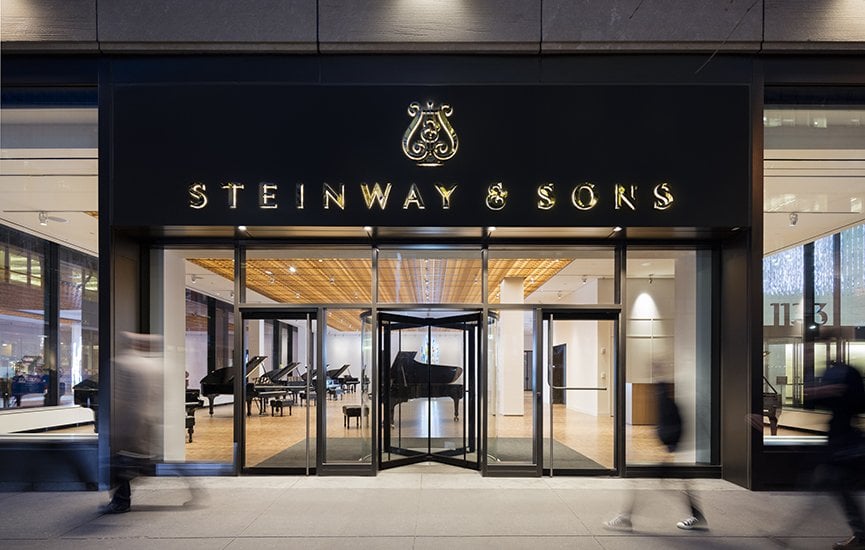
For a 163-year-old company like Steinway & Sons, innovation is bound to happen slowly—over decades, not years. But the past year has brought big changes to the Queens, N.Y.–based piano maker. It launched its Steinway Spirio player piano, the first major new product release in 70 years. And in April, it relocated its showroom and performance space to the new Steinway Hall in midtown Manhattan—the company’s first move in nearly 100 years. Worth sat down with Steinway CEO Michael Sweeney to discuss what these changes mean for the company.
Let’s start with the Steinway Spirio. What has it been like to bring a new product into such a traditional industry?
It’s been a thrill, actually. Artists tell us we can replicate their performance exactly; that means that customers at home can have a concert-quality experience as played by the world’s top artists on a Steinway. What they’re hearing is not a recording. What they’re actually hearing is the acoustic Steinway instrument. The finest recordings in the world try to replicate what the instrument actually sounds like. Now, for people who care about music and art at a high level, they can have the instrument in their home. [So] we get to share music with far more people than we ever could have before.

Are the people purchasing the Spirio new customers or returning ones?
We’ve seen some of each, but most are new. What we’re finding is that there’s a community of people who have always had respect for Steinway and would be very interested in owning a Steinway, but they didn’t play well enough—or maybe they didn’t play at all—so it didn’t make sense for them to make the investment. Now, with a self-playing piano like Steinway Spirio, it makes sense to make the investment. Steinways frequently last 100 years, and there’s no reason why that wouldn’t be true for Spirio as well.
(Read more about the Steinway Spirio in the June/July Worth feature “Homegrown Luxuries.”)
You opened the new Steinway Hall showroom in April. What was it like to move the company?
Steinway’s world headquarters was on 57th Street for a little more than 90 years. It’s a beautiful building that was designed for those times. We wanted a more contemporary space, because our work in the music community is as active and relevant today as it’s ever been. Part of that work requires having 21st-century technology available to us.
In this space, we can record an album or live stream a performance over the internet. We couldn’t have done any of that on 57th Street—we didn’t have the technology. The building on 57th Street has kind of that worn, romantic sensibility of a comfortable high-end home, which was lovely to work in, but it just didn’t speak to contemporary society the way this space is designed to do.
Hedge funder John Paulson purchased Steinway in 2013 and took it private. What has it been like since then?
I was the CEO of the company when we were publicly traded, and I can tell you that if I had to choose between building a company like Steinway in the public company environment or the private company environment, I’d choose private every time. John [Paulson] is a businessman, and he expects that we’ll create value over time—but the key phrase is over time. We don’t have the pressure of quarterly earnings calls and investors who are hanging on each quarter as a sign to progress.
I think it’s fair to say that John enabled Steinway Hall to happen. The process was underway before he bought the business, but he has been an enthusiastic supporter. We’ve made a considerable investment, and that investment will pay off for the company over time. A more short-term-thinking investor base might not have been as supportive as John has been. He genuinely sees the long-term value.
Do you think you’d ever consider moving your factories out of Astoria or Hamburg, Germany (where Steinway also has a factory)?
The craft and the artisanship that goes into making a Steinway is hard to replicate. We have many fourth- and now some fifth-generation workers in our factories. The skills are passed from generation to generation, [and that’s] something that we could never replicate. I wouldn’t know how to start a Steinway factory from scratch, quite honestly. I could start a piano factory—but not a Steinway factory. We’ll expand in Hamburg, and we’ll expand in New York as necessary—we just won’t leave.