


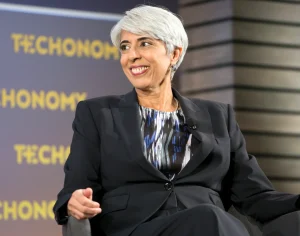
Laura is a change-making entrepreneur. In 2008 she co-founded Silver Tail Systems, a company that protected over one billion online accounts before it was acquired by RSA in December 2012. Laura began her career at the National Security Agency and then Britannica.com before pioneering anti-phishing practices for eBay and PayPal in the early 2000s. Driven by the importance of helping organizations become more productive, innovative, and effective, Laura has researched the changes required to move today’s organizations forward. Laura’s new company, Unitive, is developing software to transform the talent management landscape by bolstering traditional human resource processes with software to eliminate unconscious bias. In 2012, Laura was listed on Fast Company’s Most Creative People in Business list, Fortune’s list of Most Powerful Women Entrepreneurs, and Business Insider’s list of Most Powerful Women Engineers. She has a Ph.D. in Computer Science and a B.S. in Applied Mathematics.
 Business
Beyond Tech’s “Pipeline Problem” towards Inclusive Meritocracies
In the year since I last attended Techonomy, we’ve seen major shifts in the workforce. In 2015, millennials became the largest labor force in the United States. The U.S. Government Accountability Office estimates 40.4% of the employed labor force are now in alternative work arrangements. Employers have to find new ways to attract and retain top talent for the horizontal, distributed workforce of the future. The session I’ll join on Nov. 9, "Scouting for Talent, Digging for Diversity," will explore the causes for today's business diversity shortcomings as well as ways tech is disrupting and rebuilding the structures of old.
 Diversity
How Software Can Help Move the Needle on Diversity
Even after spending my whole career in tech, I’m still taken aback by each new diversity stat that underscores the systemic and trenchant bias in our industry. One of my recent favorites: 76 percent of feedback given to women included negative criticism of a personality trait, while only 2 percent of men received such feedback. Or this from Fenwick and West: 45 percent of tech companies in Silicon Valley don’t have a single female at the executive level, compared with only 16 percent of the rest of S&P companies.
180° Shift: The Science of Diversity
Mather: So I’m going to talk about two different 180s, and if you think about that, that’s actually a 360, but it doesn’t go that way. The first 180 is my own personal 180, and then the second one is one I think is about to occur in the human resources and psychology fields. So […]
The Digital Divide: How Can the Tech Industry Become More Inclusive?
As companies like Twitter, Facebook, Google, and Apple release their hiring data figures, the Twitter-verse explodes with commentary on the lack of diversity in the industry. This is not a new problem, but there should be new solutions. How can tech and American entrepreneurship be more inclusive? Brian Forde of the White House Office of Science and Technology Policy, Google's Chris Genteel, Laura Mather of Unitive, Marlin Page of Sisters Code, and Indiegogo's Danae Ringelmann discuss how to make the tech industry more of a melting pot in this Techonomy Detroit 2014 breakout session, moderated by Andrew Keen of TechCrunch.
 Conferences
Techonomy 15
Technology as scapegoat has driven fears since at least the industrial revolution. That is as true as ever today, with fears of privacy intrusion, our devices inducing inattention, withdrawal from human contact into screens, job-killing robots, and innumerable business models being destroyed.
 Conferences
Techonomy 14
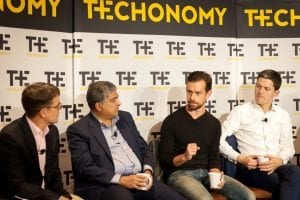
This year Techonomy moves to the beautiful Ritz-Carlton Half Moon Bay, November 9-11, on the cliffs south of San Francisco, near Silicon Valley.
 Conferences
Detroit 14
On September 16th, Techonomy returns to Detroit for our third annual Techonomy Detroit conference. We will continue the series of conversations we began at our first Techonomy Detroit in 2012 on how technology can boost U.S. economic growth, job creation and urban revival.