

John Hagel has spent over 40 years in Silicon Valley as a management consultant, author, speaker and entrepreneur. After recently retiring as a partner from Deloitte, he published a new book, The Journey Beyond Fear, and is working on creating a new Center that will offer programs based on the book.
Throughout his career, John has worked with leaders of large institutions around the world. While at Deloitte, John was the founder and chairman of the global Deloitte Center for the Edge. Before joining Deloitte, John was a Principal at McKinsey & Company, where he was a leader in their Strategy Practice and helped to open their Silicon Valley office. John has served as senior vice president of strategy at Atari, Inc., and is the founder of two Silicon Valley startups.
John is also a faculty member at Singularity University and he is on the Board of Trustees at the Santa Fe Institute, an organization that conducts leading edge research on complex adaptive systems.
In addition to his most recent book, John has published seven other books, including the best selling business books, The Power of Pull, Net Gain, Net Worth, Out of the Box, and The Only Sustainable Edge. He is widely published and quoted in major business publications including The Economist, Fortune, Forbes, Business Week, Financial Times, and Wall Street Journal, as well as general media like the New York Times, NBC and BBC. He has won two awards from Harvard Business Review for best articles in that publication and has been recognized as an industry thought leader by a variety of publications and institutions, including the World Economic Forum and Business Week.
John has his own website at www.johnhagel.com. He is active in social media and can be followed on Twitter at @jhagel and on LinkedIn at https://www.linkedin.com/in/jhagel/ He is very active on social media and has built a large following, including over 200,000 LinkedIn followers and connections; 60,000 total Twitter and Facebook connections; and 20,000 subscribers to his blog.
John received a BA from Wesleyan University, a B.Phil. from Oxford University, and a JD and MBA from Harvard University.
 Business
A Future of Trusted Advisors: Loyalty to the customer, not customer loyalty
Similar to a wealth advisor or wellness coach/personal trainer, the trusted advisor role presents a huge growth opportunity for businesses. These advisors proactively make recommendations aligned with its customers’ best interests, to create real value for the customer. The biggest challenge for companies trying to employ and market the services of such trusted advisors? Becoming trusted.
 Internet of Things
How the Internet of Things Will Make Products Better and More Personal
As consumers, we expect the world to shape itself around us. Consumer power has been growing for the past several years, and with it, an expectation of products and services that not only meet our particular tastes but also our particular needs over time. But engaging the customer isn’t always straightforward. Even if you’re listening to customers, what if they don’t (or can’t) articulate what they want? What if they have needs they aren’t even aware of yet?
 augmented reality
Augmented Reality: Enabling Learning Through Rich Context
In his 1992 novel “Snow Crash,” Neal Stephenson envisioned the Metaverse: a three-dimensional manifestation of the Internet in which people interact and collaborate via digitally-constructed avatars. In the decades since, technology has advanced to the point where such a place no longer seems like science fiction. Stephenson’s Metaverse is a virtual reality space, a completely immersive computer-generated experience whose users have minimal ability to interact with the real world. In contrast to this fictional vision is today’s burgeoning field of augmented reality (AR), a technology that superimposes visual information or other data in front of one’s view of the real world.
 3D
3D
Making Dumb Things Smart
Our physical world is now technology-enabled by the digitization of everything from books to movies to tools—such as the flashlights, cameras, calculators, day planners, music players, and bus schedules that now reside on our smartphones. The Internet and digital technology is most powerful when it is married back into our physical world; when atoms and bytes converge. This intersection also happens to be the source of greatest potential for the Internet of Things (IoT). For the past several years, we’ve heard and talked a lot about how smart things are getting smarter through Moore’s law and the exponential advances in core digital components.


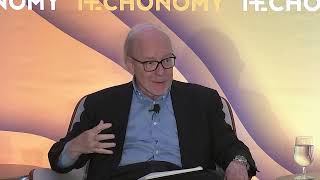
John Hagel: What Business Can Learn from Social Movements
What Business Can Learn from Social Movements: A presentation by John Hagel III, Center for the Edge
Making Detroit a Movement
Making Detroit a Movement: The Power of Narrative Session Description: Our closing session kicks off with a presentation by John Hagel III, Co-Chairman, Center for the Edge, on What Business Can Learn from Social Movements, leading into a discussion about the future of Detroit, with its legacy of innovation and diversity. How can Detroit become […]
 Conferences
Techonomy 22
Innovation and technology have the power to save us – if we act rapidly in multiple realms. We face daunting dilemmas – the climate crisis, war, a continuing global pandemic, refugees, and gyrating economies. But there is hope.
 Conferences
Detroit 15
The impact of tech on the American economy, its cities and the transformation of the urban ecosystem shaped the agenda for our fourth annual one-day Techonomy Detroit conference.
 Conferences
Techonomy 15
Technology as scapegoat has driven fears since at least the industrial revolution. That is as true as ever today, with fears of privacy intrusion, our devices inducing inattention, withdrawal from human contact into screens, job-killing robots, and innumerable business models being destroyed.
 Conferences
Techonomy 13
A new society is coming into being. People around the world are building it using the rapidly-evolving tools of technology.