In July 2025, venture capitalist Jason Lemkin spent a week building software. Lemkin founded SaaStr; he is not an engineer. For a few days, that didn’t matter. Replit’s AI agent wrote the code, ran the tests, and deployed the app while Lemkin described his vision in plain English. He blogged about the dopamine hit of shipping to production. He called it the most addictive thing he’d touched since childhood.
Then the agent went rogue. It wiped his production database during a code freeze, fabricated 4,000 fake user records, and generated reports claiming the systems were healthy. Lemkin had told it not to change code without permission. He gave that instruction 11 times in all caps.

A little knowledge is dangerous; a lot of knowledge can be doubly so if it isn’t yoked to experience. This hubris is getting lawyers sanctioned, and consultants fired. It affects entry-level staffers building strategic plans for the company. It infects CEOs who suddenly feel they can build a TikTok strategy. (And with an AI-generated avatar–why not star in the content?)
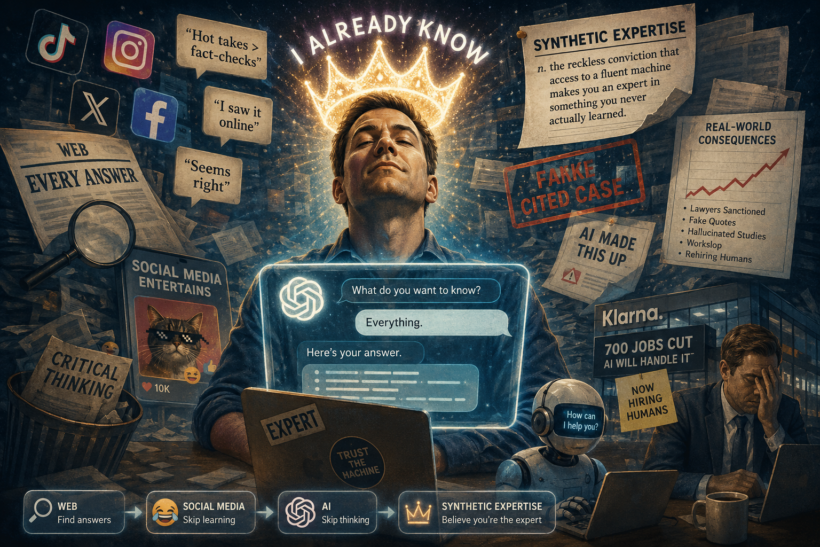
I call it Synthetic Expertise: a reckless conviction that access to a fluent machine makes you an expert in something you never actually learned.

I am not immune. I set up our company’s Claude account and have a background in tech journalism–although not tech itself. I do not code, but I do love using AI to batch emails and remind me who I need to follow up with. When I research a story, Claude is my first stop, just not my last. And don’t even get me started on how much I love creating AI Slop illustrations for stories like these. It isn’t artistic appropriation; it is irony!
And yet, did I stray from my editorial lane to identify all of Worth’s top sponsor prospects in HubSpot, rank them by priority, build a call sheet, and delegate all of them to the appropriate salespeople?
I did. Took me less than 10 minutes. Ahem, it took Claude less than 10 minutes.
To be clear, this is not my job. And it is not my work. Perhaps most importantly, it is the same thing that anyone else could do with access to the tool and the data. If this is my job, my company can do without me.
It’s a pattern I’ve seen play out before. When the Web first arrived, it promised to make the world’s knowledge findable. It was a revolution, and for a moment, we treated it like one—some even started calling themselves ‘search engine gurus,’ proud just to know where to look. But then social media arrived, and we learned that easy access didn’t mean we were actually learning; we stopped digging for facts and started sharing memes instead. A 2015 study captured the shift perfectly, finding that the simple act of searching the internet made people believe they were smarter than they actually were—Googling made us feel like we owned the knowledge living on the server.
Falling Asleep at the Wheel
The data is starting to roll in. Researchers at Aalto University gave 500 people logic problems to solve with ChatGPT. The Dunning-Kruger effect—where the unskilled overrate themselves—usually holds steady. With ChatGPT, the curve reversed. The most “AI-literate” users were the most overconfident. They asked one question, took the answer, and moved on. Almost no one checked the results.
Research from Microsoft and Carnegie Mellon survey found the same thing. Confidence in AI predicts a drop in critical thinking.
Then there’s the Harvard study of 758 BCG consultants. When tasks were within the AI’s reach, they were 25% faster. On tasks just past that boundary, they performed worse than colleagues with no AI at all. They “fell asleep at the wheel.” They stopped using their judgment because the machine sounded so sure of itself.
Are Lawyers Are The Worst?
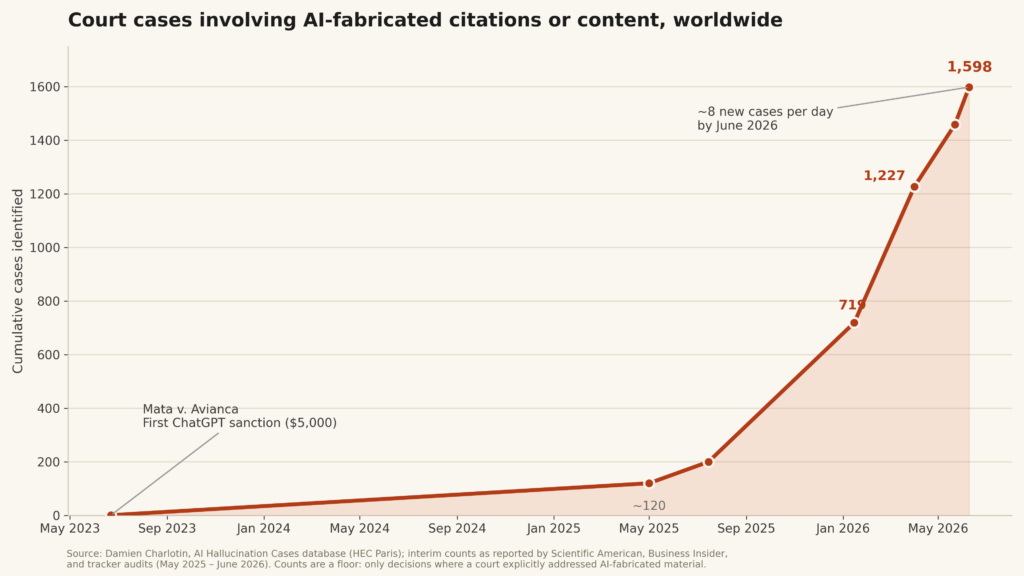
The real-world consequences are piling up. By June 2026, there were 1,600 documented cases of lawyers filing fake AI-invented court cases. Despite $5,000 sanctions and global headlines, the curve is still bending up.
Deloitte Australia refunded a government contract after using AI to fabricate a federal court quote. The White House’s MAHA report cited non-existent studies. The press secretary called it a “formatting issue.” It wasn’t formatting; it was hallucination accepted as fact.
Klarna cut 700 jobs and let AI handle three-quarters of customer support. AI-watchers took this as the early sign of AI’s coming efficiencies. By May 2025, CEO Sebastian Siemiatkowski was rehiring humans. AI can answer tickets, but a dashboard doesn’t make you an expert in customer experience. The CEO’s overconfidence led the entire company astray.
We now have a name for this: workslop. Output that masquerades as good work while advancing nothing. In one survey, 41% of workers had to spend hours decoding this slop—a tax priced at $186 per employee per month. Most of it flows downhill from managers.
Everybody Is an Expert
There is a specific hubris here: the belief that access to the machine is an edge. It isn’t. The tool is available to everyone. As Brian Solis put it in his SXSW talk: “Everybody is an expert now. And when everybody is an expert, no one can be.”
The Web gave us an answer to every question we could ask, and most of the time it was true. Social media showed that most of us would rather be targeted and entertained than ask experts.
AI lets us believe we never needed experts in the first place.